GT vs RR Match Result
Table of contents Show
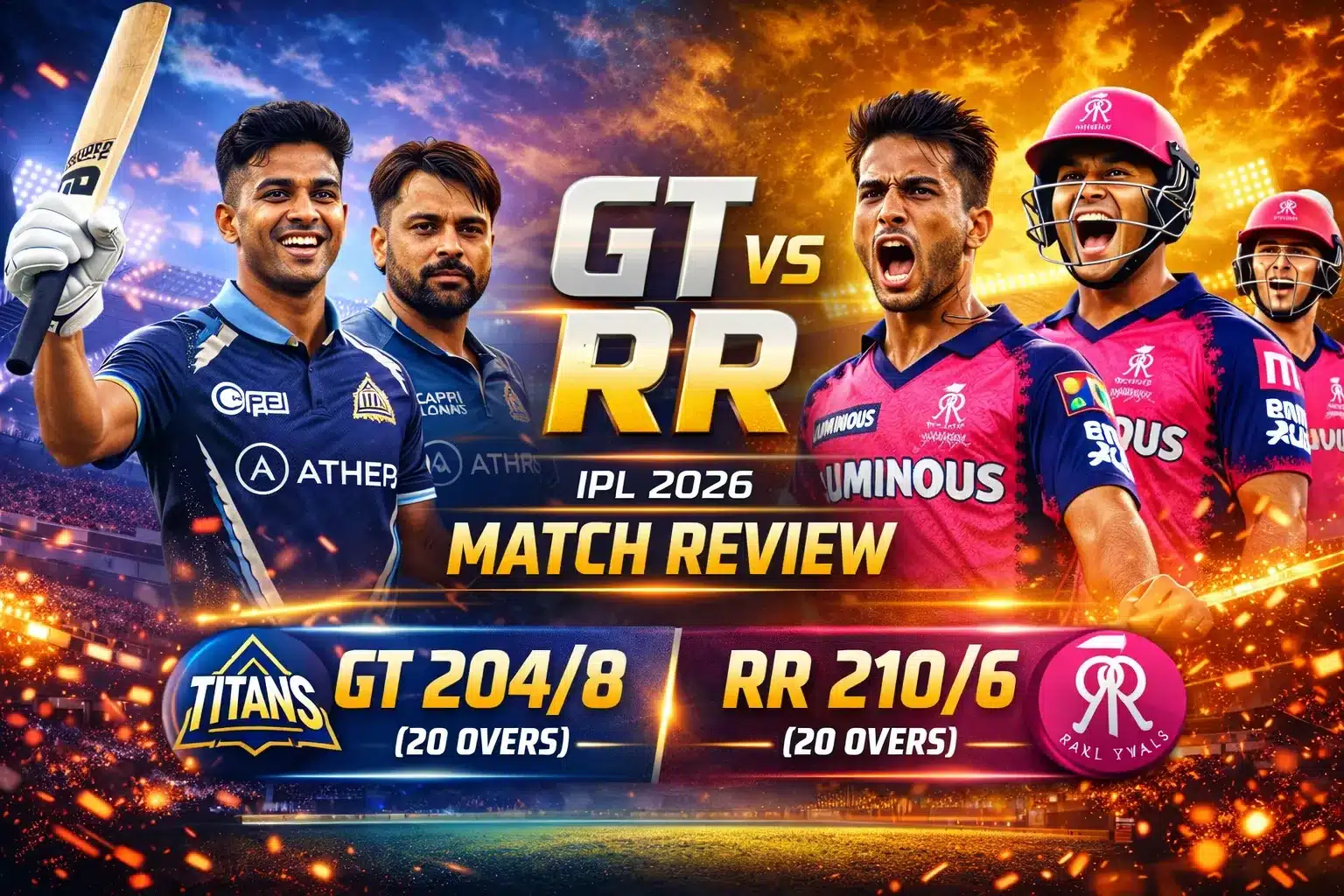
Rajasthan Royals produced the first real edge-of-the-seat finish of this IPL 2026 phase, defeating Gujarat Titans by 6 runs at the Narendra Modi Stadium in Ahmedabad. RR posted 210/6 in their 20 overs, and GT replied with 204/8, falling just short despite a strong chase built around Sai Sudharsan and a late counterattack from Rashid Khan. Ravi Bishnoi’s 4/41 earned him Player of the Match, while Tushar Deshpande and Jofra Archer combined in the closing moments to shut the door on Gujarat.
| Match | Venue | Result |
|---|---|---|
| Gujarat Titans vs Rajasthan Royals, Match 9 | Narendra Modi Stadium, Ahmedabad | Rajasthan Royals won by 6 runs |
| Team | Score |
|---|---|
| Rajasthan Royals | 210/6 (20 overs) |
| Gujarat Titans | 204/8 (20 overs) |
| Top RR performers | Top GT performers |
|---|---|
| Dhruv Jurel – 75 (42) | Sai Sudharsan – 73 (44) |
| Yashasvi Jaiswal – 55 (36) | Rashid Khan – 24 (16) |
| Ravi Bishnoi – 4/41 | Kagiso Rabada – 23 (16) |
The core numbers tell the story clearly: RR’s 210 proved just enough, GT’s chase stayed alive until the last over, and Bishnoi’s spell was the central difference between the two sides.
Rajasthan’s innings was built in two phases. The first came through an aggressive opening stand from Yashasvi Jaiswal and Vaibhav Sooryavanshi, who attacked immediately after RR chose to bat first. They added 70 in rapid time, giving Rajasthan the exact platform needed on a surface that rewarded intent. Jaiswal made 55 off 36, while Sooryavanshi struck 31 off 18 and ensured Gujarat were immediately on the defensive.
The second phase belonged to Dhruv Jurel. Once the openers had laid the foundation, Jurel took over the innings and turned a good total into a genuinely imposing one. His 75 from 42 balls came with four boundaries and five sixes, and it was not just the volume of runs that mattered but the timing of them. He accelerated through the middle and death overs, refused to let Gujarat settle, and made sure RR did not waste the powerplay advantage. By the end of the innings, Rajasthan had reached 210/6, a total that looked strong without being entirely beyond chase on that surface.
For Gujarat, Kagiso Rabada was the most effective bowler, finishing with 2/42. That return was respectable in context, but it also underlined the broader issue for GT: they never fully regained control after the fast start. The Royals were allowed to dictate tempo too often, and every time Gujarat threatened to slow the innings, another RR batter found a release shot.
Chasing 211, Gujarat did not panic. Sai Sudharsan played the innings that a chasing side needs from one of its top-order anchors. He made 73 from 44 balls, striking nine fours and three sixes, and for long stretches he kept the target in sight. Cricbuzz’s ball-by-ball summary notes that GT reached 127/2 before the chase sharply turned, which is why this defeat will hurt Gujarat: they were not blown away early, they were in the game and then let it slip.
That shift came almost entirely through Ravi Bishnoi. His 4/41 was the defining bowling spell of the match. He broke partnerships, disrupted Gujarat’s rhythm in the middle overs, and turned a controlled chase into a damaged one. Cricbuzz summed it up bluntly: GT slid from 127/2 to 161/7 once Bishnoi took charge. In T20 cricket, that kind of collapse usually decides the result, and it did here.
There was still one final twist. With regular captain Shubman Gill absent because of a muscle spasm, Rashid Khan led Gujarat and nearly dragged them over the line with a fiercely competitive 24 off 16. Rabada supported him with 23 off 16, and together they stitched a 43-run stand that gave GT one last opening. It was not classic chase management, but it was high-pressure lower-order resistance that forced RR to execute perfectly at the death.
The closing sequence was the best advertisement for Rajasthan’s composure. Riyan Parag trusted Tushar Deshpande with the final over, and Deshpande responded by bowling full, attacking the stumps, and forcing Gujarat into low-percentage strokes. The key moment came when Rashid tried to target a ball that was there to hit, only for Jofra Archer to cover ground and complete a sharp diving catch in the deep. That dismissal removed GT’s most dangerous finisher and effectively ended the chase. Rajasthan then closed the over cleanly to complete a 6-run win.
This was not only about one catch or one over. It was also about a wider team response. Archer himself pointed to the quality of RR’s fielding under pressure, and that matters because Rajasthan lost games like this in previous campaigns. Here, they looked more decisive. The bowling plans were clearer, the fielding stayed sharp late, and the captain backed an aggressive option instead of retreating to a safer one. That is often the difference between promising teams and winning teams.
Rajasthan won for three connected reasons. First, they maximized the batting conditions better than Gujarat did. Jaiswal, Sooryavanshi, and especially Jurel turned a good batting pitch into a 210-run innings. Second, Bishnoi’s middle-overs spell gave RR wicket-taking control exactly when GT still looked stable. Third, Rajasthan were better in the highest-pressure moments: Archer in the field, Deshpande in the final over, and Parag in his management of the finish.
Gujarat, by contrast, will look at the same three areas and see missed opportunities. They did enough with the bat to remain alive, but the middle overs wrecked the chase. They also had to play without Gill, and while Rashid’s leadership and late hitting kept them alive, GT still lacked the stable presence a regular top-order leader can provide once wickets started to fall. That is partly inference, but it is supported by the official match report’s note on Gill’s absence and by the timing of the collapse after GT had reached a healthy 127/2.