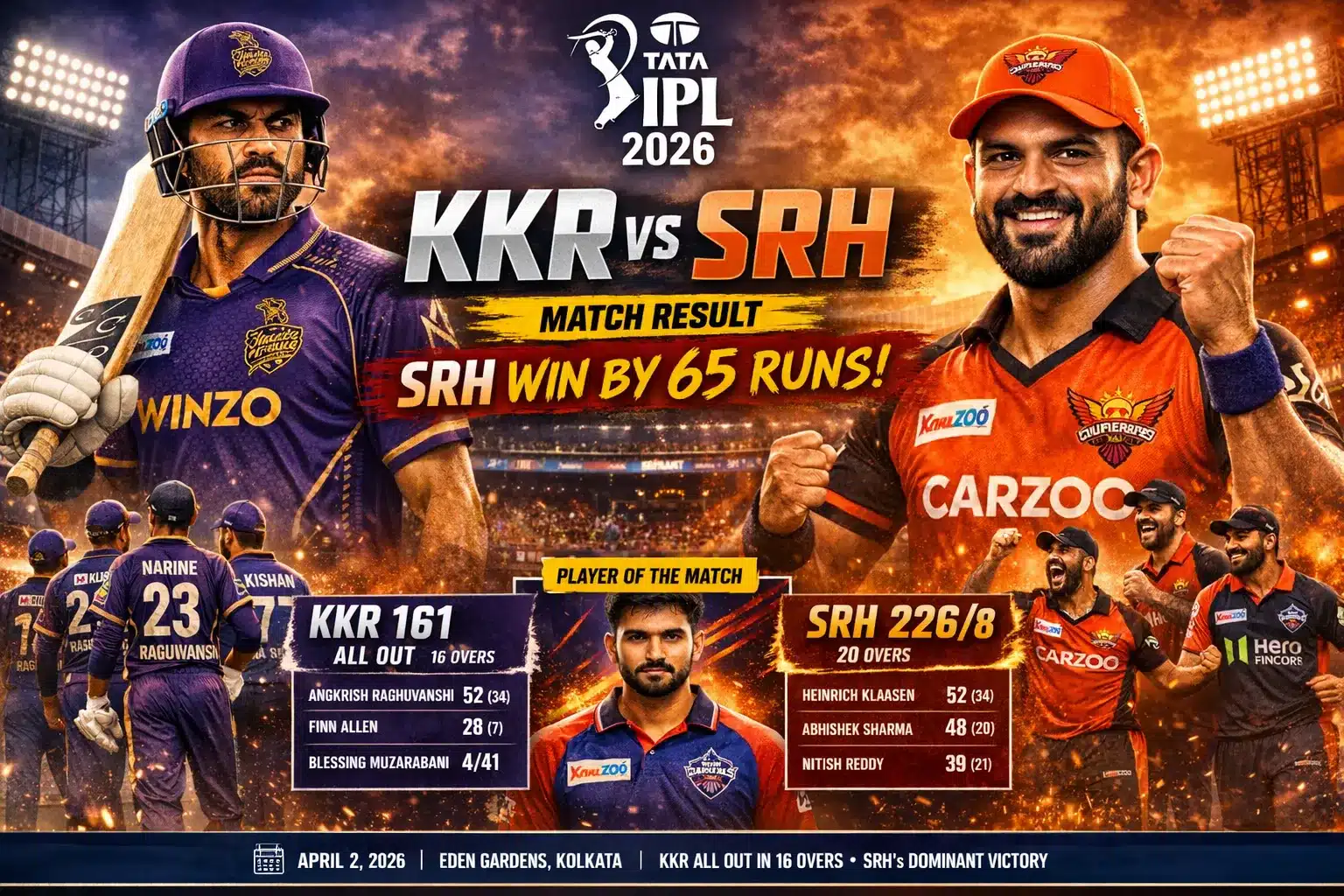
Sunrisers Hyderabad produced the kind of performance that resets a campaign. At Eden Gardens on April 2, SRH posted 226/8 and then bowled Kolkata Knight Riders out for 161 in just 16 overs, sealing a commanding 65-run victory in Match 6 of IPL 2026. The result gave SRH their first win of the season, while KKR were left to confront a defeat that was not merely heavy on the scoreboard, but troubling in the way the innings unraveled. The attached source file provided the reference set used for this match build-up and verification.
What made this result especially significant was the shape of the game. This was not a contest that drifted gradually away from KKR. For long stretches, it moved at extreme speed. SRH blasted 84 runs in the powerplay, the highest powerplay total of IPL 2026 so far, and after a brief middle-overs slowdown, Heinrich Klaasen and Nitish Kumar Reddy rebuilt the innings and carried it to a total beyond KKR’s reach. KKR, in reply, began in a frenzy of their own, reached 50 in only 20 balls, and were 120/3 in the 11th over. From there, they collapsed catastrophically, losing their last seven wickets for just 41 runs.
Match Summary
Sunrisers Hyderabad 226/8 (20 overs)
- Heinrich Klaasen 52 off 34
- Abhishek Sharma 48
- Travis Head 46
- Nitish Kumar Reddy 39
- Blessing Muzarabani 4/41 for KKR
Kolkata Knight Riders 161 all out (16 overs)
- Angkrish Raghuvanshi 52
- Finn Allen 28 off 7
- Jaydev Unadkat 3/21
- Nitish Kumar Reddy 2 wickets
- Eshan Malinga 2 wickets
Result: Sunrisers Hyderabad won by 65 runs
Player of the Match: Nitish Kumar Reddy
SRH’s innings: violence up front, control at the death
The first decisive phase came immediately. KKR won the toss and chose to bowl, a reasonable call at a venue where chasing has often tempted captains, but SRH’s openers turned the decision into a risk within minutes. Travis Head and Abhishek Sharma attacked from ball one, refusing to let KKR settle into lengths. Their intent was not reckless slogging. It was targeted, premeditated pressure. They used the pace on offer, accessed the leg side cleanly, and disrupted KKR’s plans before those plans could even be established.
The headline number was 84 in the powerplay. That figure mattered not only because of its size, but because of what it did to the rest of the innings. Once SRH reached that level of acceleration, every subsequent batter walked in with structural freedom. Singles became enough in certain pockets. Boundary options widened. Strike rotation acquired value because the platform already existed. SRH captain Ishan Kishan said afterward that the opening pair made the game easier for the rest by giving the middle order time to understand the surface. That comment was revealing. It suggested this was not a pitch where 226 was automatic. It became possible because SRH’s first six overs bent the match.
Abhishek Sharma’s 48 and Travis Head’s 46 were therefore more than brisk cameo numbers. They were strategic damage. They ensured KKR’s bowlers were pushed off their preferred plans almost instantly. When attacking teams do this well, they do not merely score fast; they alter field placements, force defensive lengths, and turn wicket-taking balls into containment balls. KKR were pushed into reaction mode, and that is usually fatal against SRH’s batting profile.
To KKR’s credit, they did find a way to stop the opening avalanche from becoming a 250-plus innings. The middle overs were not entirely one-way traffic. ESPNcricinfo’s score summary shows SRH finished 226/8, and the standout KKR bowling figure belonged to Blessing Muzarabani with 4/41, which indicates SRH did lose momentum in phases and did surrender wickets while trying to sustain the assault. That matters because there was a point where KKR might have felt the innings had been dragged back toward the 205–210 range.
But Klaasen, increasingly one of the most reliable late-innings enforcers in T20 cricket, restored SRH’s authority. His 52 off 34 was not his most explosive IPL half-century, but it was one of the more mature ones. He played the situation. He absorbed enough to keep the innings stable and attacked enough to keep KKR pinned. Around him, Nitish Kumar Reddy added 39, a contribution that looked modest only until the chase began to implode. In context, it was decisive. SRH needed batting that extended the damage beyond the opening pair, and that is exactly what Klaasen and Nitish delivered.
There was a strong tactical balance to SRH’s innings. The openers gave them brutality. Klaasen gave them shape. Nitish gave them finishing weight. That combination is dangerous because it does not depend on one batter playing a once-in-a-season innings. This was a collective construction: 48, 46, 52, 39. No century. No single-player rescue act. Just sustained pressure across phases. That is often a more ominous sign than one extraordinary knock.
KKR’s reply: a chase that exploded, then disintegrated
For about ten overs, KKR looked capable of producing one of the most outrageous chases of the season. Finn Allen came out like a man trying to end the game inside the powerplay. Cricbuzz’s commentary summary notes that he attacked Payne in the opening over with a sequence of 4, 4, 6, 6, 4, and the Indian Express scorecard snippet records Allen’s innings as 28 off just 7 balls. That start was absurdly fast even by modern IPL standards.
Angkrish Raghuvanshi then sustained the momentum with a polished 52. He was not merely a survivor amid chaos; he was an active accelerator. KKR raced to 50 in 20 balls, and despite losing wickets in the powerplay, they remained in the chase because their boundary rate kept the equation alive. When Rinku Singh joined Raghuvanshi, the match briefly entered a zone of genuine uncertainty. Cricbuzz described it as being “on a knife-edge,” and that is accurate. At 120/3 in the 11th over, KKR still had a route. It was a narrow route, but it existed.
Then the innings broke.
The collapse was not a slow failure under scoreboard pressure. It was a complete loss of control. KKR lost their final seven wickets for 41 runs. Two of those wickets were run-outs, which says something important about the mental state of the chase. Teams run themselves out when the pressure of rate, risk, and misjudgment converge. SRH created that pressure by mixing pace cleverly, protecting straight boundaries, and keeping wickets as the primary currency.
Jaydev Unadkat’s spell was central to that squeeze. His final figures of 3/21 reflected more than tidy left-arm variation. He hit awkward speeds, used angles well, and kept forcing KKR batters to generate pace instead of borrowing it. Nitish Kumar Reddy contributed two wickets, Eshan Malinga added two more, and Harsh Dubey’s dismissal of Finn Allen was one of the key early breakthroughs. The Cricbuzz post-match wrap makes the tactical point clearly: SRH were brave enough to use Harsh in the powerplay for Allen, then their pacers varied pace smartly once the game entered the decisive middle phase.
This is where the match truly swung in analytical terms. SRH’s batters had already shown that the pitch was not completely flat despite the powerplay hitting. Ishan Kishan explicitly said after the match that he did not think it was “that good” a pitch, which aligns with how the innings played out later. Once KKR were denied clean pace and easy length balls, the chase became more complicated than the early overs suggested. SRH understood the surface better by the end of the first innings, and they bowled like a side that had learned quickly.
KKR’s dismissal for 161 in only 16 overs gave the final margin a brutal look, and deservedly so. A team can lose while attacking a required rate. That happens. But this was a more serious type of defeat because KKR had already reached a position from which a competitive finish, at minimum, should have followed. Instead, the innings folded completely. That converts a respectable loss into a damaging one, both in net run-rate terms and in the internal reading of batting temperament.
Nitish Kumar Reddy’s all-round value
The Player of the Match decision went to Nitish Kumar Reddy, and there is a compelling case for it. His 39 with the bat gave SRH’s innings finishing substance after the top-order burst and Klaasen’s consolidation. Then, with the ball, he removed two left-handers in a crucial phase of the chase, including the kind of wickets that stop a counterattack from turning into something more dangerous. Cricbuzz’s post-match summary specifically notes that he got rid of Anukul Roy and Rinku Singh from round the wicket. That is not cosmetic impact; that is match-defining intervention.
His post-match comments also offered useful context. He spoke about injuries, negative thoughts, and working hard on his bowling ahead of the season. That matters because SRH’s balance becomes far more threatening when Nitish is not merely a batting option but a genuine all-round contributor. T20 sides are transformed by players who let them cover both batting depth and bowling flexibility with one selection. Nitish gave SRH exactly that.
What went wrong for KKR
Several issues converge here.
First, KKR’s bowling never fully recovered after the first six overs. Muzarabani’s 4/41 suggests he found a way to salvage impact, but SRH’s start ensured those strikes came after heavy damage had already been done. KKR did not own the powerplay with the ball, and against this SRH top order, that is a dangerous concession.
Second, the batting order played two very different games in one innings. The first phase was fearless and productive. The second phase lacked composure. Aggression was not the problem. The absence of control was the problem. Once Allen fell and the chase moved beyond the shock-and-awe opening, KKR needed one substantial partnership to keep SRH under pressure. They did not find it.
Third, the fielding and running details hurt them. Two run-outs in a chase of 227 are self-inflicted wounds. Chasing big totals already requires near-perfect sequencing. Gifting dismissals destroys that equation.
Fourth, there are emerging tactical questions around KKR’s balance. Cricbuzz’s report quoted Ajinkya Rahane acknowledging that the side might need to think about their combination and whether an extra batter is needed if they bowl first. That is not panic language, but it is the language of a team aware that its current structure may not be solving enough problems under pressure.
What this win means for SRH
For SRH, this was the performance of a side reminding the tournament what its ceiling looks like. They had lost their opener, but this victory restored both points and identity. The batting template was familiar: attack relentlessly at the top, then trust the middle order to convert platform into intimidation. The bowling, though, may be the more important takeaway. SRH did not defend the total through sheer scoreboard pressure alone. They defended it with intelligent pace variation, wicket-taking intent, and a clear understanding of matchups.
A team that can score 226 away from home and still bowl with tactical discipline rather than just emotional momentum is a team that will trouble everyone. SRH’s powerplay hitting gets the attention, but their smarter sign here was their response once KKR counterpunched. Lesser teams panic at 120/3 in the 11th over. SRH did not. They held shape and finished the game clinically.
Final verdict
The official result will read simply enough: Sunrisers Hyderabad beat Kolkata Knight Riders by 65 runs. But the match said more than that. It said SRH remain one of the most explosive batting units in the competition when Head and Abhishek gain early access to the tempo. It said Klaasen still provides elite middle-order assurance. It said Nitish Kumar Reddy’s all-round development could materially raise SRH’s ceiling. And it said KKR, for all their firepower, are still vulnerable to panic once a chase moves from instinct to calculation.
For KKR, the defeat was severe because it exposed both tactical and psychological fragility. For SRH, the victory was valuable because it was not just a win; it was a complete performance. They blasted, recalibrated, and closed. In a league where momentum shifts rapidly, this looked like the kind of result that can reorder a season.