Views: 8
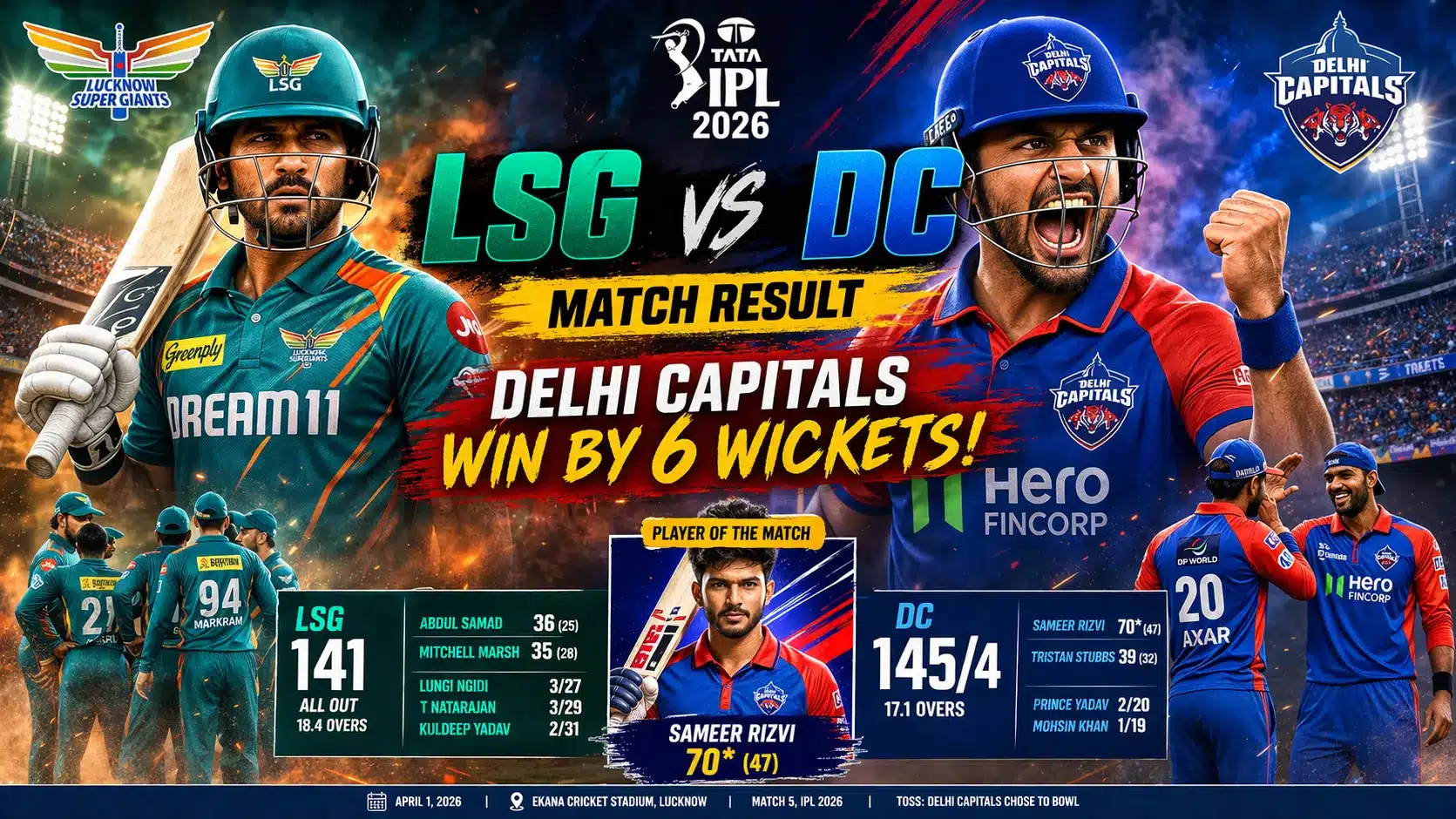
On April 1, 2026, in Lucknow at the Bharat Ratna Shri Atal Bihari Vajpayee Ekana Cricket Stadium, the clash between Lucknow Super Giants and Delhi Capitals did not turn into the usual IPL run-fest of 190-plus totals. This was a different kind of game: a sticky start, a surface that kept gripping, constant pressure on the batters, and a match in which one correct partnership decided everything. Delhi Capitals defeated Lucknow Super Giants by 6 wickets: the home side were bowled out for 141 in 18.4 overs, and DC reached the target with 145/4 in 17.1 overs. Player of the Match was Sameer Rizvi, who scored 70 off 47 balls and played exactly the kind of innings that separates a talented player from one who can actually close out difficult chases in the IPL.
This match is deceptive if you only look at the score. On paper, it seems as if DC simply controlled the chase after restricting the opposition to a weak first-innings total. In reality, Delhi themselves entered a dangerous zone: the top order collapsed before 30, and for a while LSG genuinely had the game in their hands. But the difference between the two teams came down to two things. First, the quality of DC’s destruction in the middle phase of LSG’s innings. Second, DC’s ability not to panic after early losses and not to try to win the game in two overs. Rizvi and Stubbs did the exact opposite: first they took the tempo away from LSG, then they took away their confidence, and only then did they take away the match.
Match Summary
| Parameter | Value |
|---|---|
| Match | Lucknow Super Giants vs Delhi Capitals, IPL 2026, Match 5 |
| Date | April 1, 2026 |
| Venue | Ekana Cricket Stadium, Lucknow |
| Toss | Delhi Capitals won the toss and chose to bowl |
| LSG | 141 all out (18.4 overs) |
| DC | 145/4 (17.1 overs) |
| Result | Delhi Capitals won by 6 wickets |
| Player of the Match | Sameer Rizvi |
| Top batter for LSG | Abdul Samad — 36 (25) |
| Top batter for DC | Sameer Rizvi — 70 (47) |
| Best bowler for DC | Lungi Ngidi — 3/27 |
| Best bowler for DC | T Natarajan — 3/29 |
| Best bowler for LSG | Prince Yadav — 2/20 |
| Best bowler for LSG | Mohsin Khan — 1/19 |
The result, scoreline, and key individual performances are confirmed by multiple sources from your file.
The Score Alone Already Tells a Lot
141 all out in 18.4 overs is a failure for a home side in the modern IPL unless the pitch is extremely difficult. Yes, Ekana can be sticky, not the easiest surface for clean timing, and not always a venue for pure power-hitting. But even on such a pitch, 141 is a total that requires nearly perfect defending. LSG did not get that perfect defense because they gave away too much while building their own innings. And when the captain says after the match that extras hurt, that is not a generic press-conference line. It is an exact description of the problem: when you are defending 141, you cannot hand away free runs.
Delhi, meanwhile, did the opposite. They won the toss and chose to field first, which looked like a pragmatic and mature decision on such a surface. First, test how the pitch behaves in real match rhythm. Then force the opposition to bat under the pressure of early wickets. Then in the chase, do not follow a blind “run-a-ball at any cost” template, but instead read the spells and isolate the weak link. That is exactly what Rizvi and Stubbs did.
How Lucknow Super Giants’ Innings Fell Apart
It did not begin as a disaster for LSG. It began as a sticky fight. But there was a critical tactical point: Rishabh Pant moved up in the order, and after the match he explained it as an attempt to create a left-right combination at the top. He also made it clear that whether he opens again is 50-50, though he will stay in the top order. That matters because the match against DC showed something important: it is one thing to expand your options on paper, and quite another to disrupt a working structure against an attack that immediately found its length.
LSG lost control not through one major collapse, but through a series of small breakdowns. The most painful moment was Pant’s run-out. The Indian Express live report records that Marsh played the ball, it ricocheted off Mukesh Kumar’s hand onto the stumps at the non-striker’s end, and Pant was found outside his crease and dismissed for 7 off 9. That was not just a wicket. It was a direct blow to the logic of the reshuffled top order: the captain moved up, but delivered neither tempo nor calm.
After that, the innings never found a proper spine. Aiden Markram, Mitchell Marsh, Nicholas Pooran, Pant — too many names who were supposed to build the bulk of the runs collectively failed. Indian Express summed it up directly: LSG’s big hitters failed to fire, and the highest individual score came from Abdul Samad, who made 36 off 25. For a team with that many power-hitters, that is a harsh diagnosis.
Key Moments in LSG’s Collapse
| Moment | What Happened | Why It Mattered |
|---|---|---|
| Pant run-out | Pant dismissed for 7 (9) | Loss of the captain and loss of structure |
| Pooran cleaned up by Ngidi | Pooran 8 (8) | The main middle-order accelerator removed |
| Badoni out to Natarajan | 0 (3) | LSG failed to find a stabilizer after setbacks |
| Marsh out to Kuldeep | 35 (28) | The only top-order batter holding the innings together departed |
| Mukul out | 14 (11) | Even a useful cameo did not become a bridge to 155+ |
| Samad out at the death | 36 (25) | The final real hope of a late surge disappeared |
These phases from the live coverage show clearly why 141 was not bad luck. It was the natural outcome of how the innings unfolded.
DC’s Bowlers Won the Match Before the Chase Began
If there was a hidden architect of this victory, it was not one man but the entire DC bowling unit. Formally, Player of the Match was Rizvi, and that is fair because the chase became tense. But the foundation was built by Lungi Ngidi, T Natarajan, and Kuldeep Yadav. Ngidi finished with 3/27 in 3.4 overs, Natarajan had 3/29 in 4 overs, and Kuldeep took 2/31 in 4 overs. Outlook even noted that Ngidi may have produced a contender for the ball of the tournament, while the trio as a whole made life miserable for LSG. That is not exaggeration. The figures and the nature of the dismissals support it.
Ngidi was especially important because he did not just take wickets — he disrupted the batters’ expectations of pace. Pooran was bowled by a cutter that beat the swing and crashed into the stumps. On a surface where the ball was not arriving evenly, those variations became even more valuable. Ngidi also wrapped up the innings, taking 3 wickets in less than a full spell. This is one of those cases where 3/27 looks standard on paper, but its real influence on the match was far greater.
Natarajan did a different kind of work — simpler, but no less valuable. He removed players at exactly the stages where LSG were trying either to stabilize or to accelerate. Badoni fell for 0 (3), Samad for 36 (25), and Shami for 1 (2). In other words, Natarajan shut down both the middle phase and the death overs. He did not allow LSG to turn 105/5 after 13 overs into something like 155/6 by the end. And that kind of late push at Ekana could have radically altered the chase.
Kuldeep, meanwhile, did what he is usually picked for in T20 cricket: not just control, but removal of the right batters. Marsh departed for 35 off 28 just when it looked as if he could drag the innings to a competitive finish. Then Mukul Choudhary, whose debut cameo looked useful, was also dismissed. With Pooran already gone and Pant lost to a run-out, these middle-over strikes fully broke the structure of the LSG innings.
Best Performances of the Match
Top Batters
| Player | Team | Runs | Balls | Role |
|---|---|---|---|---|
| Sameer Rizvi | DC | 70 | 47 | Match-winner, anchor-finisher |
| Tristan Stubbs | DC | 39 | 32 | Supported the chase, absorbed pressure |
| Abdul Samad | LSG | 36 | 25 | The only real late aggressor for LSG |
| Mitchell Marsh | LSG | 35 | 28 | The best top-order batter for LSG |
These main batting contributions are reflected in the match coverage and result summaries.
Top Bowlers
| Player | Team | Figures | Impact |
|---|---|---|---|
| Lungi Ngidi | DC | 3/27 | Removed the middle order and killed acceleration |
| T Natarajan | DC | 3/29 | Closed down the middle and death overs |
| Kuldeep Yadav | DC | 2/31 | Took key wickets in the middle overs |
| Prince Yadav | LSG | 2/20 | Created pressure at the start of the chase |
| Mohsin Khan | LSG | 1/19 | Held a disciplined line and denied easy runs |
The bowling figures are confirmed in the score summaries.
DC’s Chase: First a Collapse, Then Precision
This chase is what makes the match interesting from a columnist’s perspective, rather than just another low-scoring result. Delhi did not move smoothly to the target. On the contrary, they lost KL Rahul, Pathum Nissanka, Nitish Rana, and Axar Patel before even reaching 30. Indian Express put it bluntly: DC lost Rahul, Nissanka, Rana and Axar before crossing 30. In a chase of 142, that is not automatically fatal, but it is already a serious tactical emergency. In such situations, chasing sides often make one of two mistakes: they either retreat too deeply into survival mode, or they try to force the game back in one over. DC did neither.
Prince Yadav deserves mention here because he gave LSG genuine hope by removing Nissanka. The live report records: Pathum Nissanka c Rishabh Pant b Prince Yadav 1 (5). The early pressure was absolutely real. And at that moment, the match shifted from “routine chase” mode into a character test.
Then came the rebuilding by Rizvi and Stubbs. What matters is not just the final partnership value, but how it was built. Up to a point, they did not try to “break” the game. They tried to level it. After 8 overs, DC were 53/4. After 9 overs, 61/4. After 10 overs, 77/4, with Shahbaz Ahmed hit for 16 runs in the over. After 12 overs, 87/4. After 13 overs, 93/4. That sequence says a lot: first calm rebuilding, then a targeted attack on the vulnerable bowler, then back to control. That is an intelligent T20 chase, not just a random burst of boundaries.
The decisive tactical break came against Shahbaz. Indian Express records the over where Rizvi collected 16 runs: using the knee, pulling, finding boundaries through different arcs, and suddenly the required equation softened dramatically. After that, LSG no longer dictated the terms. They still created a few half-chances, but the script had changed. Rizvi then reached his fifty, and in the 16th over the partnership crossed 100. From that point, the chase was effectively under Delhi’s control.
Why Sameer Rizvi Became the Face of the Match
A 70 not out off 47 balls in a chase of 142 does not look monstrous by raw strike-rate standards. But this innings cannot be judged outside context. When the top order collapses, the match stops being about elegance and becomes about risk geometry. Rizvi gave Delhi Capitals three things at once.
First, permanence at the crease. As long as one set batter remains there, bowlers cannot fully relax their tactical discipline or go all-in with reckless attacking fields. Second, pressure on spin. In post-match remarks, Stubbs noted that Rizvi naturally takes on spin, and that this made the chase easier. Third, the right timing of acceleration. He did not chase boundaries immediately. He waited for the right matchups, then punished Shahbaz, then got to fifty, then drove the stand to 100. This was not just a talented innings. It was a smart innings.
It was also fitting that the match ended with his six. Indian Express notes that in the 18th over Rizvi slammed a six to finish the chase, and DC won by 6 wickets. It was the perfect closing image for an innings built not on spectacle from the first ball, but on discipline.
Tristan Stubbs: Not the Headline Hero, But the Structural Hero
Stubbs made 39 off 32, the kind of score that often disappears behind a bigger innings. But in this match, his contribution was critical. He did not allow Rizvi to stand alone against a stream of overs. He rotated strike, found the occasional boundary, and most importantly, he did not lose his wicket at the exact stage when LSG were desperately searching for one breakthrough to expose the tail.
In his post-match comments, Stubbs admitted he was not even fully padded up when he had to walk in, but the task was clear: spend time at the crease and bat sensibly. That is exactly what he did. He also said that one good over could change the equation, and after such an over the chase became close to run-a-ball. That is a precise description of what happened. The Rizvi–Stubbs partnership did not explode all at once. It slowly removed every comeback path for LSG.
The Partnership That Won the Match
| Phase | Match Situation |
|---|---|
| Early DC collapse | LSG in the game, pressure very high |
| Rizvi + Stubbs settle | Tempo slows, but wickets stop falling |
| Weak over attacked | Pressure shifts to LSG |
| Rizvi reaches fifty | DC gain psychological control |
| 100-run partnership | The chase is almost closed |
| Final strike | Rizvi finishes with a six |
This was a classic T20 template: survive, isolate, punish, finish.
Why LSG Lost the Match Not Only with the Bat, But Tactically
Lucknow’s defeat cannot be explained only by a weak batting display. Yes, 141 all out was the central reason. But tactically, the team also left questions behind.
1. The top-order experiment failed
Pant admitted after the match that they wanted to try a left-right combination at the top. It looked experimental. On paper, the idea may have logic, but against an attack that quickly found rhythm, the move disrupted stability more than it delivered benefits.
2. Extras while defending a small total
When a captain says extras hurt, it is almost an admission of a second defeat inside the first one. When you are defending 141, you cannot give away wides and gift runs, especially in overs where you yourself have created pressure through wickets. DC had phases in the chase where free runs reduced the equation without batting risk.
3. No finishing burst
After 13 overs, LSG were 105/5. After 15 overs, 121/6. After 17 overs, 135/6. This was the window in which a normal death-overs surge could have lifted them to 150+. But the wickets of Samad and then the tail ended that possibility.
4. No second wave after early success in the chase
LSG did an excellent job grabbing DC by the throat when the visitors lost four batters before 30. But after that, they had no Plan B against two set batters. Shahbaz’s 16-run over was the turning point not only on the scoreboard, but in resource management. In low-scoring defenses, these are the overs that usually kill the defending side’s chances.
Timeline of the Key Turning Points
| Match Moment | Event | Impact |
|---|---|---|
| Toss | Axar Patel wins toss, DC bowl first | Delhi chose the pragmatic route |
| Early LSG innings | Pant run-out | LSG lose structure |
| Middle overs LSG | Pooran bowled by Ngidi | Main accelerator removed |
| Middle overs LSG | Marsh out for 35 | Last serious top-order pillar gone |
| Late LSG innings | Samad makes 36, but without support | Not enough to reach 150+ |
| Early DC chase | 4 wickets before 30 | LSG return strongly into the match |
| DC rebuilding | Rizvi + Stubbs settle | Pressure begins to shift |
| 10th over of chase | Rizvi punishes Shahbaz, 16-run over | Match momentum flips |
| 16th over of chase | 100-run stand comes up | DC almost home |
| 17.1 overs | Rizvi finishes with a six | Match sealed |
These key moments are supported by the live report, score summary, and post-match reactions.
What This Result Means for Both Teams
For Delhi Capitals, this win is worth more than just two points. It matters psychologically. The team won the match in two different ways on the same night: first through a disciplined bowling unit, then through a controlled chase under collapse pressure. Wins like this often matter more than a comfortable 200/3 against 180/7. They show that the side can survive in discomfort.
For Sameer Rizvi, this may prove to be a statement match. For Stubbs, it confirmed his value as a crisis-handler. For the bowling core, it was a reminder that DC can win on difficult, ugly surfaces too.
For Lucknow Super Giants, the message is harsher. The problem is not only one defeat. The problem is that the match exposed structural questions: batting order, lack of a reliable spine after the first blow, dependence on isolated bursts rather than a constructed innings. Pant said afterward that one positive was the way the team fought with the ball. That is true. But having to fight with the ball after making 141 is already a sign that the batting blueprint failed first.
Final Verdict from a Sports Columnist
LSG vs DC was not a match about a giant total. It was a match about the quality of decisions under pressure. Lucknow Super Giants did not lose it in one over or with one wicket. They lost it layer by layer: a questionable reshuffle at the top, the captain’s run-out, the middle-order power game failing, no late surge, and the inability to regain control once Delhi were under pressure. Delhi Capitals, in contrast, won it through mature persistence. They won it with bowling discipline, patience, and one major innings that arrived exactly when it was needed most.
The official scoreboard says it simply: LSG 141 all out, DC 145/4, Delhi won by 6 wickets. But the real meaning goes deeper. This was a night when DC showed they could move through turbulence. And LSG received a hard reminder: in the IPL, big names are not enough. A team needs a clear innings structure, especially on a surface that gives runs to nobody for free.
In simple terms:
- Delhi Capitals fully deserved the win.
- Sameer Rizvi played a high-class innings.
- Stubbs delivered the ideal supporting role.
- Ngidi, Natarajan, and Kuldeep broke LSG’s batting in stages.
- Lucknow Super Giants lost tactically almost as badly as they lost on the scoreboard.
These are exactly the kind of matches that get remembered later in the season as signals. For DC, a signal that the team may be more dangerous than it looks on paper. For LSG, a signal that even at home, without a clear batting shape, it will be difficult to build a stable run of victories.
Author

Author