Match Summary
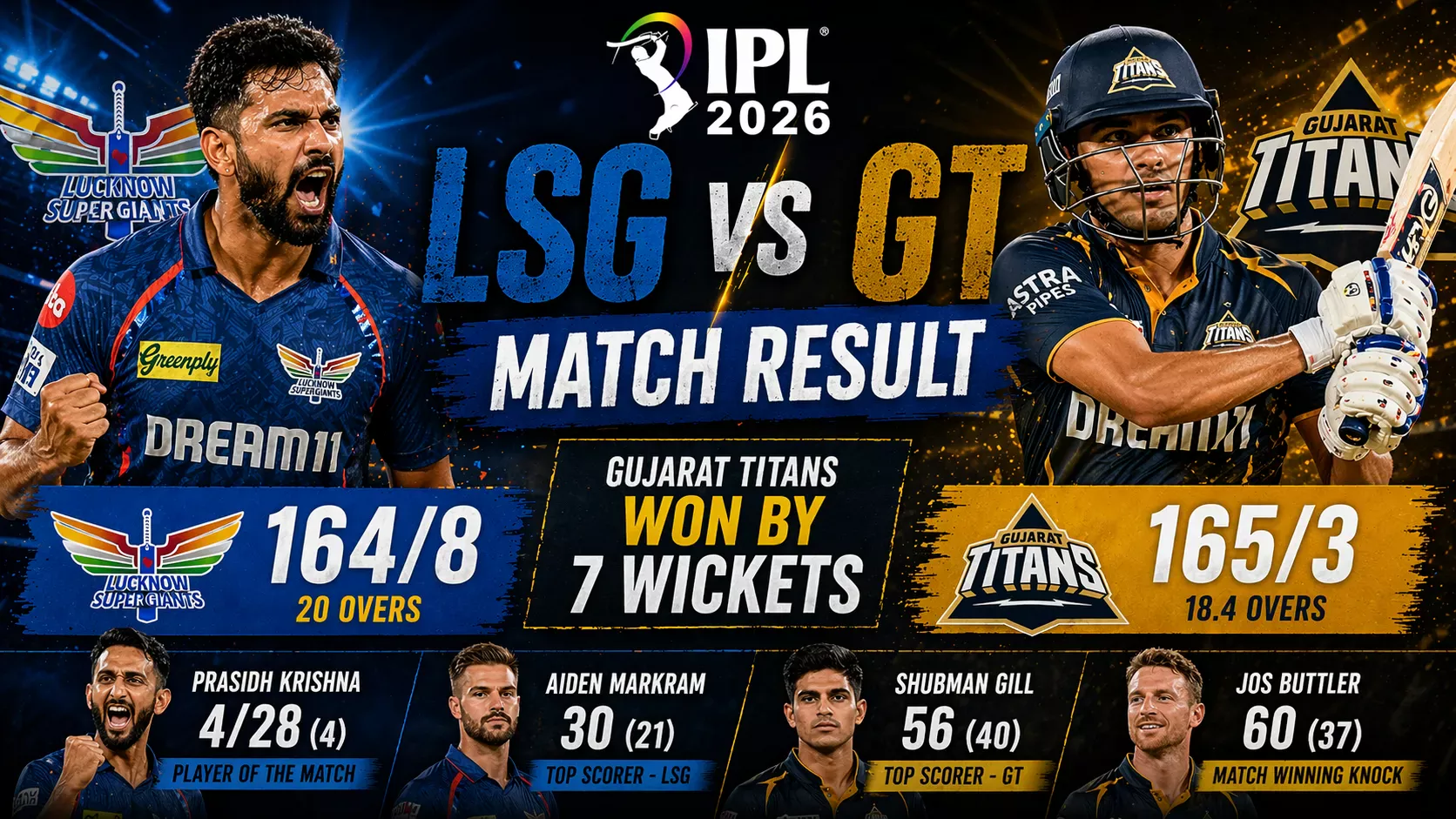
Gujarat Titans produced one of their most controlled performances of IPL 2026, beating Lucknow Super Giants by 7 wickets at the Bharat Ratna Shri Atal Bihari Vajpayee Ekana Cricket Stadium in Lucknow on April 12. LSG made 164/8 in 20 overs, but GT chased 165/3 in 18.4 overs, with Prasidh Krishna’s 4/28 setting the tone before Shubman Gill and Jos Buttler removed most of the risk from the chase. Prasidh was named Player of the Match.
This was not a thriller built on late chaos. It was a match decided by control. Gujarat won the toss, chose to field, and then squeezed Lucknow through the exact phase that usually defines T20 innings: overs 7 to 16. LSG were 60/2 after the powerplay and still had enough batting left to recover, but GT kept hitting hard lengths, mixed pace well, and never let the innings settle. By the time Lucknow reached 117/5 at the 16-over timeout, the match had already tilted heavily toward the visitors.
Match summary
The figures below come from the official ESPN scorecard and IPL match report.
| Item | Detail |
|---|---|
| Match | Lucknow Super Giants vs Gujarat Titans, Match 19, IPL 2026 |
| Venue | Bharat Ratna Shri Atal Bihari Vajpayee Ekana Cricket Stadium, Lucknow |
| Toss | Gujarat Titans won the toss and elected to field |
| LSG total | 164/8 in 20 overs |
| GT total | 165/3 in 18.4 overs |
| Result | Gujarat Titans won by 7 wickets |
| Player of the Match | Prasidh Krishna |
LSG innings: early intent, then a long collapse
Lucknow did not begin poorly. Mitchell Marsh came out swinging, Markram found boundaries, and Rishabh Pant counterattacked hard enough to keep the scoring rate healthy. But the innings was unstable almost from the start. Marsh fell for 11 off 4, Pant made 18 off 11, and once Siraj removed Pant at 45/2, GT had already forced LSG into a reset before the powerplay was even over.
Aiden Markram was the one top-order batter who looked capable of building something substantial. He made 30 off 21, but Prasidh Krishna removed him at the end of the sixth over, and that dismissal changed the mood of the innings. Ayush Badoni then made only 9 off 11, Nicholas Pooran labored to 19 off 21, and the scoring rate began to sag. IPL’s official report noted that GT’s pace attack kept using the short ball effectively, with Prasidh taking key wickets as the middle overs turned into a squeeze rather than a rebuild.
The collapse was not dramatic in one over. It was worse than that for Lucknow: it was gradual and sustained. LSG slid from 69/3 to 74/4, then to 109/5, then to 118/6. Pooran, who is usually the batter who can reset the strike rate in two overs, never got going. Abdul Samad made 18 off 22, which is the kind of innings that can only survive if someone at the other end is exploding. That never happened. Mukul Choudhary’s 18 off 14 and George Linde’s 16 off 10 added some late value, but by then the innings had already lost shape.
Lucknow’s final total of 164/8 only became mildly respectable because 33 runs came off the last two overs, with Mohammed Shami smashing 12 not out from 5 balls and Linde contributing late boundaries. Without that finish, this could easily have been a total in the low 140s. That late burst made the scoreboard less ugly, but it did not change the core truth of the innings: GT owned the middle.
LSG batting card
The batting figures below are from the official scorecard.
| LSG batter | Runs | Balls | 4s | 6s | Strike rate |
|---|---|---|---|---|---|
| Aiden Markram | 30 | 21 | 5 | 1 | 142.85 |
| Mitchell Marsh | 11 | 4 | 1 | 1 | 275.00 |
| Rishabh Pant | 18 | 11 | 2 | 1 | 163.63 |
| Ayush Badoni | 9 | 11 | 1 | 0 | 81.81 |
| Nicholas Pooran | 19 | 21 | 0 | 2 | 90.47 |
| Abdul Samad | 18 | 22 | 2 | 0 | 81.81 |
| Mukul Choudhary | 18 | 14 | 1 | 1 | 128.57 |
| George Linde | 16 | 10 | 3 | 0 | 160.00 |
| Mohammed Shami* | 12 | 5 | 1 | 1 | 240.00 |
| Avesh Khan* | 4 | 1 | 1 | 0 | 400.00 |
| Extras | 9 | — | — | — | — |
| Total | 164/8 | 20 overs | — | — | 8.20 RPO |
GT with the ball: Prasidh was the match
Prasidh Krishna’s spell was the defining performance of the first innings. He finished with 4/28, but the raw numbers do not fully show the pattern of his impact. He removed Markram, Badoni, Pooran, and Mukul Choudhary, repeatedly using hard lengths, slower short balls, and awkward angles into the pitch. ESPN’s match notes and the IPL report both point to the short ball as the key weapon, and Lucknow never solved it cleanly.
Mohammed Siraj also deserves more credit than the wicket column alone suggests. His 1/19 in four overs was the most economical spell of the innings, and his dismissal of Pant cut off a potentially dangerous partnership early. Rashid Khan did not take a wicket, but his 4 overs for 25 kept pressure on a batting unit that was already struggling to reset. Rabada’s figures of 1/54 look expensive, yet even he struck early by removing Marsh and prevented LSG from turning the opening overs into a full launch.
GT bowling card
The bowling figures below are from the official scorecard.
| GT bowler | Overs | Runs | Wickets | Economy |
|---|---|---|---|---|
| Mohammed Siraj | 4 | 19 | 1 | 4.75 |
| Kagiso Rabada | 4 | 54 | 1 | 13.50 |
| Ashok Sharma | 4 | 32 | 2 | 8.00 |
| Prasidh Krishna | 4 | 28 | 4 | 7.00 |
| Rashid Khan | 4 | 25 | 0 | 6.25 |
GT chase: not explosive, just superior
Gujarat’s reply was much calmer than Lucknow’s innings. Sai Sudharsan made 15 off 14 before falling at 45/1, but that wicket changed almost nothing because Gill and Buttler took over immediately. The pair added 84 for the second wicket, which was the stand that ended the game in practical terms. By the time Gill fell for 56 off 40 in the 15th over, GT were already 129/2 and the target was down to a formality.
Gill’s innings was measured rather than spectacular. He reached his fifty off 34 balls and played the anchor role with just enough tempo to keep the chase in control. Buttler was sharper and more forceful. He made 60 off 37, struck 11 fours, reached his fifty in 29 balls, and consistently punished any attempt to pull the scoring rate back. The important detail is not only that both made fifties. It is that they did it in different ways, which prevented LSG from settling on one defensive plan.
Lucknow had a brief opening when they removed Gill at 129/2 and Buttler at 135/3, but the target was already too small by then. Washington Sundar’s unbeaten 21 off 13 and Rahul Tewatia’s 10 off 8 took GT home with eight balls remaining. This is what a controlled chase of 165 looks like: one partnership strips out the pressure, and the finish becomes routine rather than dramatic.
GT batting card
The batting figures below are from the official scorecard.
| GT batter | Runs | Balls | 4s | 6s | Strike rate |
|---|---|---|---|---|---|
| Sai Sudharsan | 15 | 14 | 3 | 0 | 107.14 |
| Shubman Gill | 56 | 40 | 6 | 1 | 140.00 |
| Jos Buttler | 60 | 37 | 11 | 0 | 162.16 |
| Washington Sundar* | 21 | 13 | 2 | 1 | 161.53 |
| Rahul Tewatia* | 10 | 8 | 1 | 0 | 125.00 |
| Extras | 3 | — | — | — | — |
| Total | 165/3 | 18.4 overs | — | — | 8.83 RPO |
LSG with the ball: decent spells, no pressure chain
Lucknow’s bowling figures are not disastrous in isolation. Prince Yadav returned 1/31, Digvesh Rathi had 1/31, and Shami picked up Buttler late. But there was no pressure chain. One wicket came at 45/1, then the next not until 129/2, by which point the game had drifted too far. GT were never forced into a rebuilding phase like the one Lucknow had endured. That is the difference between taking wickets and changing a match.
Phase comparison
The phase numbers below come from ESPN’s match notes and scorecard.
| Phase | LSG | GT |
|---|---|---|
| Powerplay | 60/2 | 52/1 |
| Score after 14 overs | 109/5 at 14.3 overs | 128/1 at 14 overs |
| Biggest partnership | No stand beyond early bursts | Gill-Buttler added 84 |
| Final total | 164/8 | 165/3 |
| Finish | Used full 20 overs | Won with 8 balls left |
This table explains the match better than the final margin. LSG actually scored faster in the powerplay, but they lost two wickets and never recovered the structure of the innings. GT scored slightly slower early, lost only one wicket, and then owned the middle overs through one long partnership.
Turning points
| Moment | Why it mattered |
|---|---|
| Siraj dismisses Pant at 45/2 | Cut off LSG’s best chance of a stable top-order build |
| Prasidh removes Markram at 69/3 | Ended the only innings that looked capable of carrying LSG deep |
| Prasidh gets Badoni and later Pooran | Turned LSG from shaky into stuck |
| LSG reach only 117/5 by the 16-over timeout | Left too much for the tail to repair |
| Gill-Buttler add 84 for the second wicket | Removed almost all scoreboard pressure from the chase |
| GT lose Gill and Buttler only after 129 and 135 | By then the chase was effectively over |
These moments come directly from the score progression and match report.
Tactical reading
The tactical lesson is blunt. Gujarat were better in the phase that matters most in T20 cricket: the stretch after the powerplay when hitting becomes harder and decision-making gets exposed. Lucknow had enough batting to post 180-plus, but GT’s seamers kept forcing miscues into the leg side with short-ball variation. That prevented any one LSG batter from turning a start into command.
Then Gujarat chased like a side that knew exactly how much risk the surface required. They did not need a 200-style assault. They needed two proper innings, low panic, and no collapse. Gill and Buttler delivered exactly that. One anchored, one pressed harder, and together they made 165 look small.
Final verdict
Gujarat Titans did not steal this match. They controlled it. Prasidh Krishna dismantled the middle order, Siraj and Rashid kept the squeeze tight, and then Gill and Buttler replaced uncertainty with method. LSG’s 164/8 was never fully safe, and once GT reached 128/1 after 14 overs, the result was essentially settled. This was a clean seven-wicket win built on bowling discipline first and batting certainty second.