Match Summary
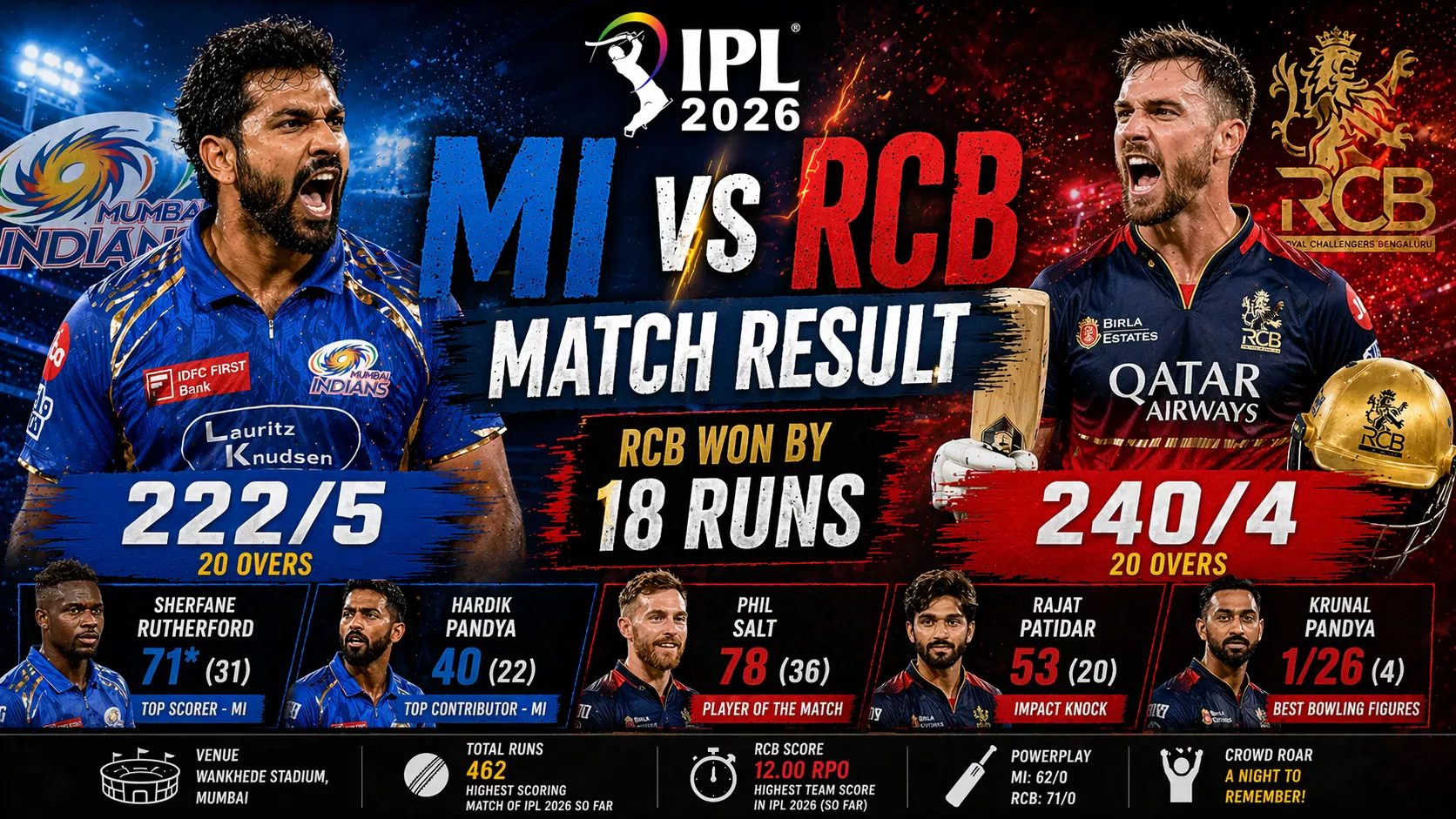
Royal Challengers Bengaluru beat Mumbai Indians by 18 runs in Match 20 of IPL 2026 at the Wankhede Stadium on April 12 after piling up 240/4 and then holding MI to 222/5. Phil Salt was named Player of the Match for a 78 off 36, while Sherfane Rutherford’s unbeaten 71 off 31 turned the last overs into noise and panic without quite changing the result.
This was not a match built on one twist. It was a match built on wave after wave of damage. RCB won the first phase with Salt, controlled the middle with Kohli and Patidar, and then added late force through Tim David. MI replied with enough power to stay alive, but two soft wickets in the eighth over and a stretch of control from Krunal Pandya left them chasing the game instead of dictating it. Rutherford nearly reversed that script at the end, but the target had already been stretched too far.
Match summary
The figures below come from the official ESPN scorecard and IPL match report.
| Item | Detail |
|---|---|
| Match | Mumbai Indians vs Royal Challengers Bengaluru, Match 20, IPL 2026 |
| Venue | Wankhede Stadium, Mumbai |
| Toss | Mumbai Indians won the toss and elected to field |
| RCB total | 240/4 in 20 overs |
| MI total | 222/5 in 20 overs |
| Result | RCB won by 18 runs |
| Player of the Match | Phil Salt |
| Combined runs | 462 |
RCB innings: Salt detonated, Patidar accelerated harder, MI never recovered the damage
Mumbai chose to bowl first, which normally makes sense at Wankhede. RCB responded by making the new ball irrelevant. Salt attacked from the outset, Kohli fed off the pressure he created, and RCB were already 71/0 in the powerplay. They reached 100 in 8.4 overs, and the opening partnership was worth 120 in just 10.5 overs. That start did not merely build a platform. It forced MI’s bowlers to spend the rest of the innings reacting.
Salt’s innings was the one that ripped the match open. He made 78 off 36 with 6 fours and 6 sixes, and the IPL’s official report described his innings as a “breathtaking performance” that dismantled Mumbai’s attack right from the powerplay. His fifty came off 25 balls, and his scoring rate ensured Kohli never had to manufacture risk early.
Kohli’s 50 off 38 was much calmer, but it had real structural value. He gave RCB continuity after the powerplay and allowed the innings to survive the moment when Salt fell at 120/1. Then Rajat Patidar did the real second-stage damage. He hammered 53 off 20 with 4 fours and 5 sixes, reached fifty in only 17 balls, and transformed a strong launch into a huge total. At 187/2 after 15 overs, RCB had already gone beyond “good Wankhede score” territory.
Tim David’s unbeaten 34 off 16 finished the job. His late hitting mattered because it kept the innings rising after Patidar fell. Instead of finishing around 220 to 225, RCB pushed to 240/4, and that extra layer is exactly what protected them later once Rutherford started emptying the stands.
RCB batting card
These batting numbers are from the official scorecard.
| RCB batter | Runs | Balls | 4s | 6s | Strike rate |
|---|---|---|---|---|---|
| Phil Salt | 78 | 36 | 6 | 6 | 216.66 |
| Virat Kohli | 50 | 38 | 5 | 1 | 131.57 |
| Rajat Patidar | 53 | 20 | 4 | 5 | 265.00 |
| Tim David* | 34 | 16 | 2 | 3 | 212.50 |
| Jitesh Sharma | 10 | 9 | 1 | 0 | 111.11 |
| Romario Shepherd* | 2 | 2 | 0 | 0 | 100.00 |
| Extras | 13 | — | — | — | — |
| Total | 240/4 | 20 overs | — | — | 12.00 RPO |
MI with the ball: Bumrah was solid, but the rest leaked too much
The scorecard exposes the problem immediately. Jasprit Bumrah went wicketless but still gave away only 35 in four overs. Hardik Pandya was reasonable at 1/39, and Santner removed Patidar while returning 1/43. Everyone else bled. Boult went for 50, Markande for 40 in only two overs, and Shardul Thakur for 32 in two overs despite taking Salt’s wicket. RCB’s top order won too many matchups too early, and Mumbai never reset control.
The slow over-rate penalty also mattered in a game like this. ESPN’s match notes show MI had to keep an extra fielder inside the circle from 19.1 to 20.0, which is exactly the phase when containment becomes most fragile on a high-scoring ground. It is not the main reason they lost, but it is part of why RCB squeezed every possible run out of the finish.
MI chase: fast enough early, but the eighth over changed the match
Mumbai’s chase was not timid. They reached 62/0 in the powerplay, and Rohit Sharma looked fluent before retiring hurt on 19 off 13 with a hamstring issue at 57/0. Ryan Rickelton made 37 off 22, and for the first seven overs MI were tracking the chase without panic. On a night when 240 was on the board, that mattered.
Then came the decisive interruption. Suyash Sharma removed Rickelton at 72/1 and Tilak Varma at 74/2 in the eighth over, and MI’s early flow broke immediately. Those were not just wickets. They were momentum kills. A chase of 241 can survive one wicket; it struggles to survive two soft dismissals in four balls right when acceleration should continue.
Suryakumar Yadav made 33 off 22, but Krunal Pandya got him at 121/3 in what the IPL report called a crucial spell. Krunal’s four overs cost only 26 in a match with 462 runs, which is the kind of economy that feels almost abnormal in this context. He did not take a bag of wickets, but he distorted MI’s scoring rhythm at the exact moment they needed one batter to keep the rate under control.
Hardik Pandya tried to force a re-entry into the game with 40 off 22. It was violent enough to keep the equation moving, but not long enough to change the geometry of the chase. When he fell at 145/4 in the 15th over, MI needed a final-over miracle kind of finish. Rutherford almost supplied it.
Rutherford’s unbeaten 71 off 31 was the wildest innings of the chase. He hit 9 sixes, reached fifty off 26 balls, and dragged MI from defeat by a comfortable margin into something that looked briefly unstable. NDTV’s live summary noted he hit four sixes in the final over alone to cut the loss margin. But by the time the onslaught arrived, MI had already lost too much time and too many wickets in the middle overs.
MI batting card
These batting numbers are from the official scorecard.
| MI batter | Runs | Balls | 4s | 6s | Strike rate |
|---|---|---|---|---|---|
| Ryan Rickelton | 37 | 22 | 3 | 3 | 168.18 |
| Rohit Sharma | 19 retired hurt | 13 | 2 | 1 | 146.15 |
| Suryakumar Yadav | 33 | 22 | 5 | 0 | 150.00 |
| Tilak Varma | 1 | 3 | 0 | 0 | 33.33 |
| Hardik Pandya | 40 | 22 | 6 | 1 | 181.81 |
| Sherfane Rutherford* | 71 | 31 | 1 | 9 | 229.03 |
| Naman Dhir | 1 | 2 | 0 | 0 | 50.00 |
| Mitchell Santner* | 8 | 6 | 1 | 0 | 133.33 |
| Extras | 12 | — | — | — | — |
| Total | 222/5 | 20 overs | — | — | 11.10 RPO |
RCB with the ball: Krunal’s spell was worth more than flashier numbers
If someone looked only at wicket counts, they might say Suyash Sharma’s 2/47 was the decisive bowling figure. It was important, but Krunal’s 1/26 in four overs was the more valuable spell in context. In a game where both teams scored above 11 an over, Krunal went at 6.50 and removed Suryakumar. The IPL report explicitly called it a match-defining spell, and that description fits.
Jacob Duffy was expensive at 1/58, but he did take Hardik’s wicket. Rasikh Salam also made a useful impact after coming in as the Impact Player, returning 1/23 in 2.5 overs and dismissing Naman Dhir. Bhuvneshwar Kumar went wicketless, yet his 4/38 was stable enough in a chaotic run chase.
RCB bowling card
These figures are from the official scorecard.
| RCB bowler | Overs | Runs | Wickets | Economy |
|---|---|---|---|---|
| Jacob Duffy | 4 | 58 | 1 | 14.50 |
| Bhuvneshwar Kumar | 4 | 38 | 0 | 9.50 |
| Rasikh Salam | 2.5 | 23 | 1 | 8.11 |
| Krunal Pandya | 4 | 26 | 1 | 6.50 |
| Suyash Sharma | 4 | 47 | 2 | 11.75 |
| Romario Shepherd | 1.1 | 28 | 0 | 24.00 |
Phase comparison: the first six overs were not enough to decide it
The phase numbers below come from ESPN’s match notes and scorecard.
| Phase | RCB | MI |
|---|---|---|
| Powerplay | 71/0 | 62/0 |
| Score at 8 overs / 9 overs marker | 95/0 in 8 overs | 85/2 in 9 overs |
| 100 reached | 8.4 overs | 10.1 overs |
| Strategic timeout | 187/2 in 15 overs | 147/4 in 15 overs |
| Final total | 240/4 | 222/5 |
This table explains the match clearly. MI were not blown away at the start. They stayed close enough in the powerplay. The real difference came immediately after. RCB were 95/0 after eight overs; MI were 74/2 after 7.5 and 85/2 after nine. That is the stretch where the chase lost symmetry.
Turning points
| Moment | Why it mattered |
|---|---|
| RCB race to 71/0 in the powerplay | Forced MI’s attack into reactive lengths and fields |
| Salt-Kohli put on 120 | Removed all early pressure from the innings |
| Patidar’s 53 off 20 | Converted a platform into a near-elite total |
| Rohit retires hurt at 57/0 | Broke MI’s opening flow just before transition overs |
| Suyash removes Rickelton and Tilak | Turned a live chase into a disrupted one |
| Krunal dismisses Suryakumar | Killed MI’s most natural stabilizing route |
| Rutherford’s 71* off 31 | Reduced the margin, but arrived too late to overturn the match |
All of those moments are visible in the official score progression and the IPL match report.
Tactical reading
RCB won this match by being more complete in the transition overs. Salt destroyed the powerplay, but the real strength of the innings was that it did not stall after his dismissal. Kohli held shape, Patidar exploded, and David kept the finish alive. That made the batting effort layered rather than one-dimensional.
Mumbai’s chase, by contrast, had power but not enough continuity. The side still reached 222, which tells you how flat the surface was and how destructive Rutherford became. But once Rohit went off hurt and the double strike landed in the eighth over, MI were playing catch-up. Reuters later quoted Hardik Pandya saying “a lot of things need a rethink,” especially with bat and ball and in the powerplay. That is a fair reading. The scoreline was close at the end, but RCB owned too many key sections of the match.
Final verdict
This was one of the loudest batting nights of IPL 2026 so far, but it was not random chaos. RCB built 240 through sequencing: Salt for destruction, Kohli for continuity, Patidar for surge, David for closure. MI had enough firepower to threaten the chase, especially through Rutherford, but not enough control in the middle overs to truly own it. The final 18-run margin looks narrow because the ending was violent. The match itself was won earlier.