Match Summary
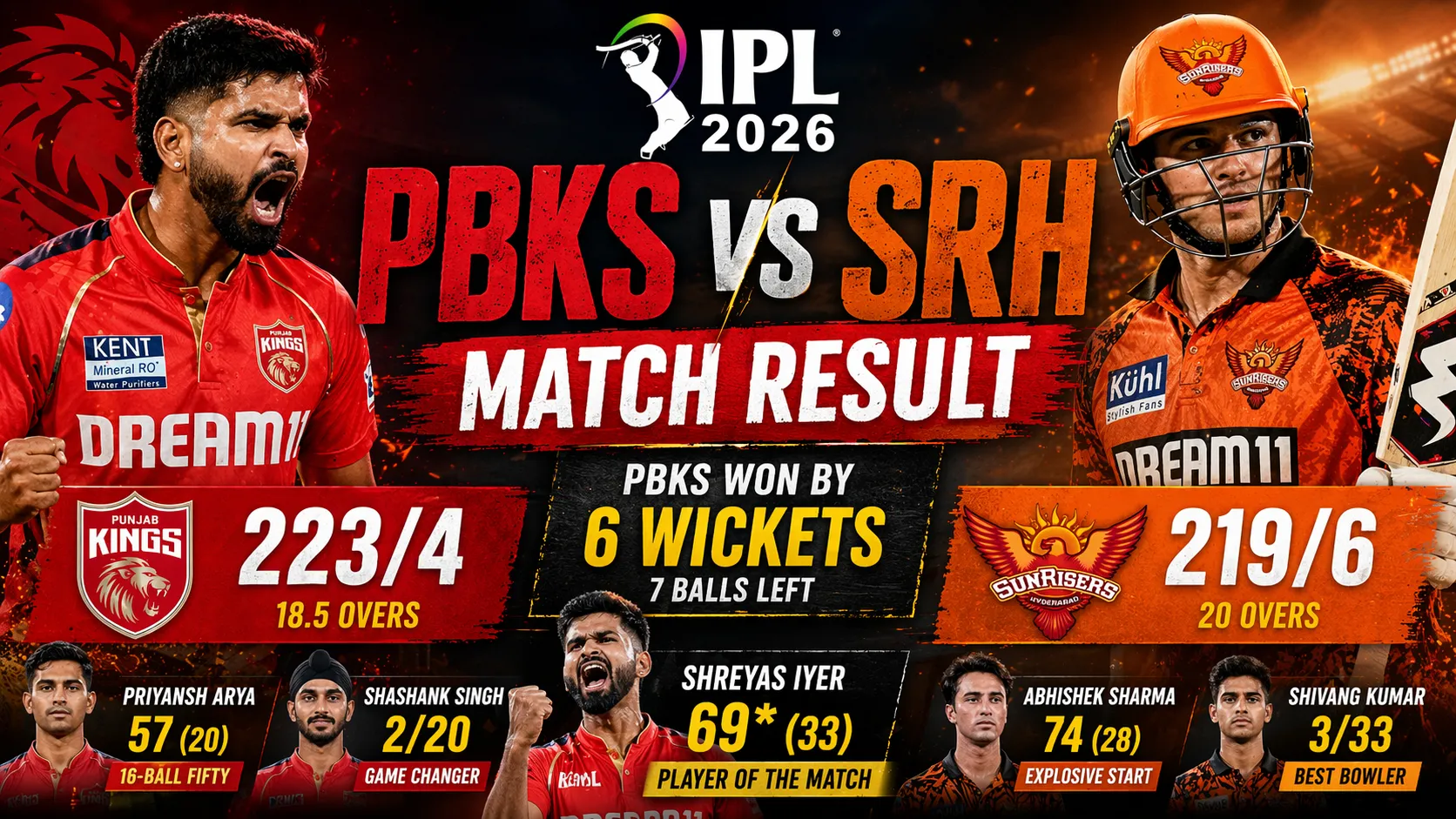
Punjab Kings produced one of the cleanest chases of IPL 2026, hunting down 220 to beat Sunrisers Hyderabad by 6 wickets with 7 balls left at the Maharaja Yadavindra Singh International Cricket Stadium in New Chandigarh on April 11, 2026. SRH blasted 219/6 after a monstrous start, but PBKS replied with 223/4 in 18.5 overs, with Shreyas Iyer finishing unbeaten on 69 off 33 and taking Player of the Match.
What makes this result more interesting than the raw score is the shape of the game. SRH looked set for something closer to 240 or even 250 after reaching 105/0 in the powerplay, but PBKS dragged the innings back through the middle. Then Punjab almost mirrored the early assault with 93/0 in their own powerplay and, unlike Hyderabad, did not lose control after the first burst. That difference in middle-overs composure decided the match.
Match summary
| Item | Detail |
|---|---|
| Match | Punjab Kings vs Sunrisers Hyderabad, Match 17, IPL 2026 |
| Venue | Maharaja Yadavindra Singh International Cricket Stadium, New Chandigarh |
| Toss | Punjab Kings won the toss and elected to field |
| SRH total | 219/6 in 20 overs |
| PBKS total | 223/4 in 18.5 overs |
| Result | Punjab Kings won by 6 wickets |
| Player of the Match | Shreyas Iyer |
These details come directly from the official score records.
SRH innings: 105 in the powerplay, then the brakes came on
Sunrisers Hyderabad came out in full attack mode. Abhishek Sharma and Travis Head detonated from ball one, taking SRH to 105/0 in the first six overs, which the IPL match report described as the third-joint highest powerplay total in IPL history. The opening pair added 120 in just 8 overs, with Abhishek smashing 74 off 28 balls and Head making 38 off 23. At that point, SRH had the game in a position where 230-plus looked normal.
Then the match flipped. Shashank Singh, used as a part-time option, removed Head at 120/1 and Abhishek at 122/2 in the same over-phase, and SRH never fully rebuilt the same tempo. Ishan Kishan contributed 27 off 17 and Heinrich Klaasen made 39 off 33, but the innings lost its violence after the openers fell. From the end of the powerplay, SRH managed only 77 runs for 3 wickets across the next 10 overs, and from 105/0 after 6 overs they finished on 219/6 rather than something more intimidating.
A major moment in that slowdown came when Marco Jansen produced a one-handed boundary catch to dismiss Ishan Kishan off Arshdeep Singh. That wicket cut off a fresh surge just as SRH were trying to relaunch. The dismissal of Klaasen later for 39 also hurt, because he was the only batter after the openers who looked capable of lifting the total back into the 230s.
SRH batting card: the innings in one table
| SRH batter | Runs | Balls |
|---|---|---|
| Abhishek Sharma | 74 | 28 |
| Travis Head | 38 | 23 |
| Ishan Kishan | 27 | 17 |
| Heinrich Klaasen | 39 | 33 |
| Salil Arora | 9 | 8 |
| Nitish Kumar Reddy | 0* | 1 |
| Harsh Dubey | 1* | 2 |
| Extras | 13 | — |
| Total | 219/6 | 20 overs |
Key wicket-takers for PBKS were Shashank Singh with 2/20, Arshdeep Singh with 2/50, and Xavier Bartlett with 1/42.
PBKS chase: same violence early, much better control later
Punjab’s reply was not cautious. It was direct counterattack. Priyansh Arya and Prabhsimran Singh launched immediately, pushing PBKS to 93/0 in the powerplay. Arya reached a 16-ball fifty and finished with 57 off 20, while Prabhsimran made 51 off 25. That opening pair gave Punjab 99 runs before the first wicket fell in the seventh over, which meant the chase never developed the usual scoreboard anxiety that comes with 220 pursuits.
The difference from SRH’s innings appeared right after the hot start. Hyderabad went from full control to partial stall once wickets fell. Punjab lost Priyansh, then Prabhsimran, then Cooper Connolly, but still kept the chase stable. At 128/3 in 10.2 overs, the match was still alive. From there, Shreyas Iyer took over the structure of the innings. He stayed unbeaten on 69 off 33, striking at over 209, and stitched a 69-run stand off 35 balls with Nehal Wadhera. By the time Wadhera fell, the equation had dropped to 23 off 23, which effectively ended the contest.
Shashank Singh then stayed with Iyer to close the chase. He made 16 not out from 9, while Iyer remained the dominant figure through the finishing stretch. The raw scorecard says 223/4 in 18.5 overs, but the more useful reading is this: Punjab turned a 220 chase into a controlled pursuit because their captain absorbed the pressure that SRH never managed after losing their openers.
PBKS batting card: why the chase worked
| PBKS batter | Runs | Balls |
|---|---|---|
| Priyansh Arya | 57 | 20 |
| Prabhsimran Singh | 51 | 25 |
| Cooper Connolly | 11 | 12 |
| Shreyas Iyer | 69* | 33 |
| Nehal Wadhera | 14 | 14 |
| Shashank Singh | 16* | 9 |
| Extras | 5 | — |
| Total | 223/4 | 18.5 overs |
For SRH, Shivang Kumar was the only bowler with meaningful wicket impact, taking 3/33. The rest of the attack could not contain the chase: Harshal Patel went for 39 in 2 overs, Eshan Malinga 46 in 3 overs, and Jaydev Unadkat 40 in 3 overs.
Phase comparison: this is where Punjab won
| Match phase | SRH | PBKS |
|---|---|---|
| Powerplay | 105/0 | 93/0 |
| Opening stand | 120 runs in 8 overs | 99 runs in 6.2 overs |
| After first burst | Lost momentum | Kept scoring rate stable |
| Final total | 219/6 | 223/4 |
| Finish | Used all 20 overs | Won with 7 balls left |
This table explains the result better than any headline. SRH had the bigger launch, but PBKS had the cleaner chase architecture. Punjab were slightly behind in the first six overs, yet far better from overs 7 to 16.
Turning points
| Moment | Why it mattered |
|---|---|
| SRH race to 105/0 in 6 overs | Put PBKS under extreme pressure early |
| Shashank Singh removes Head and Abhishek | Broke the most destructive batting partnership of the game |
| Marco Jansen catch to dismiss Kishan | Stopped SRH from building a second acceleration phase |
| PBKS reach 93/0 in powerplay | Neutralized scoreboard pressure almost instantly |
| Iyer-Wadhera add 69 in 35 balls | Converted a dangerous chase into a manageable equation |
Each of these moments is visible in the official score progression and match report, and together they show how the match turned from SRH domination into PBKS control.
Tactical reading
The first tactical lesson is simple: 220 is not automatically safe on a flat IPL surface when the opposition starts with license to attack. The second is more important: powerplay destruction is only half the job. SRH won the first six overs harder than PBKS did, but Punjab won the match because they handled the transition better after wickets started falling. That is an inference from the scoring pattern, but it is a strong one: Hyderabad fell from 105/0 to 169/3 by the end of the 14th over and finished on 219/6, while Punjab moved from 93/0 to 197/4 by 16.1 overs and never allowed the chase to tighten.
The third lesson concerns flexibility. PBKS got bowling value from Shashank Singh, an unlikely disruptor, and then batting control from Iyer, who did not need a century or even an all-out slog to decide the result. He provided shape, tempo, and timing. That is usually what separates a successful 200-plus chase from a highlight reel that still ends in defeat.
Final verdict
This was not just a high-scoring game. It was a very specific kind of T20 win: Punjab Kings absorbed a brutal first punch, prevented SRH from converting a historic start into a truly match-proof total, and then chased 220 with less panic than the target deserved. Arya and Prabhsimran blew open the door, but Shreyas Iyer was the reason PBKS walked through it without losing balance. On a day when 219 could easily have been enough, Punjab made it look one phase short.