RR vs CSK Match Result
Table of contents Show
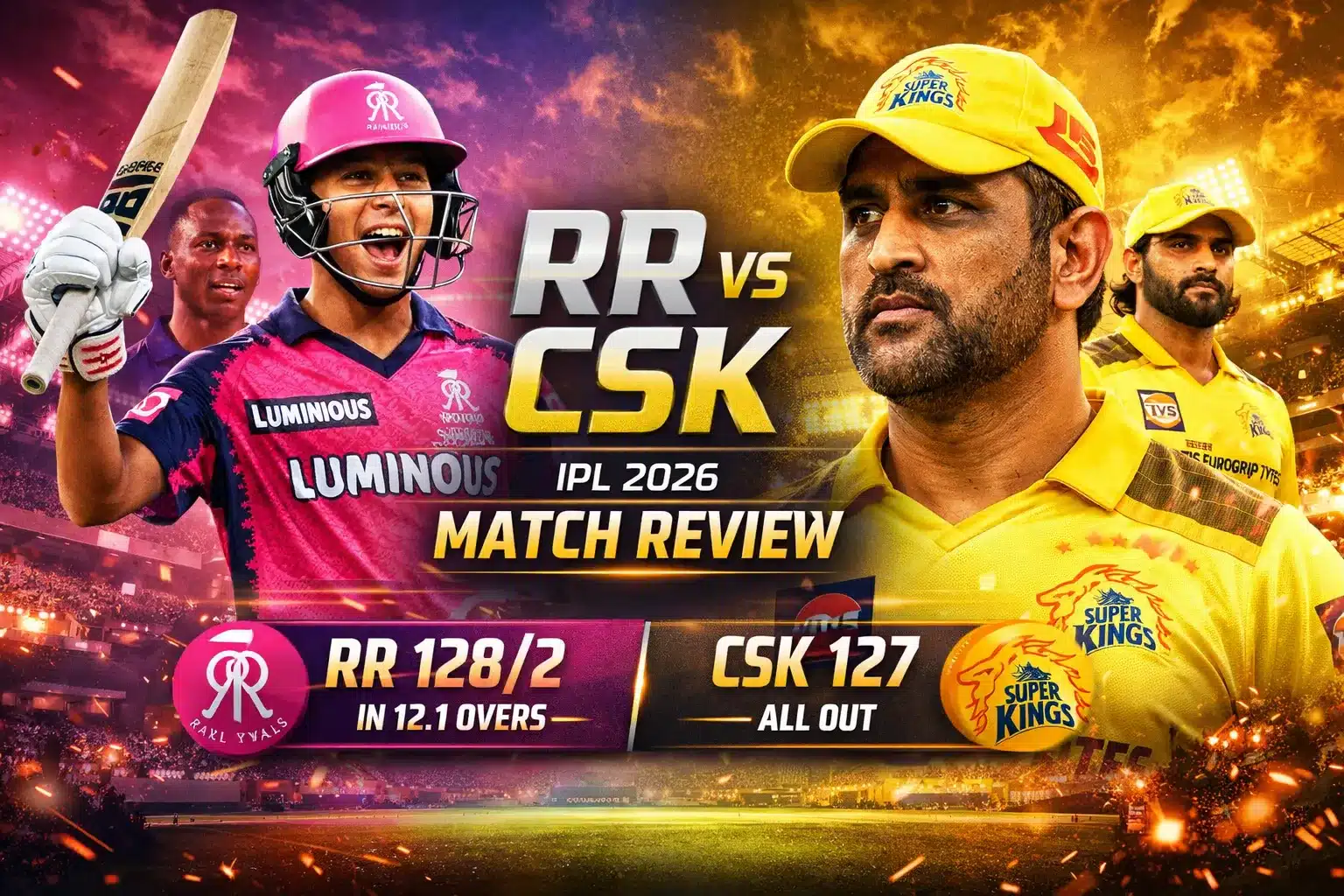
Rajasthan Royals opened their IPL 2026 campaign with a crushing win over Chennai Super Kings, beating them by eight wickets with 47 balls remaining in Guwahati. CSK were bowled out for 127 in 19.4 overs, and RR replied with 128/2 in just 12.1 overs. On the scoreboard alone, it was one-sided. In context, it was even more severe: Rajasthan controlled the match in the powerplay with the ball, then removed all doubt in the powerplay with the bat. ESPNcricinfo’s result summary, scorecard snippet, and match report all frame this as a comprehensive dismantling rather than a narrow chase.
The match had two clear phases. In the first, RR’s attack broke Chennai’s batting shape almost immediately. In the second, 15-year-old Vaibhav Sooryavanshi tore through the chase so quickly that the required target ceased to matter. ESPNcricinfo’s match-statistics snippet shows CSK stumbling to 41/4 in the powerplay, while RR stormed to 74/0 in their own first six overs. That contrast is the cleanest explanation of the game. Chennai lost early control and never regained it; Rajasthan established control and then accelerated beyond resistance.
| Team | Score | Overs | Result |
|---|---|---|---|
| Chennai Super Kings | 127/10 | 19.4 | Lost |
| Rajasthan Royals | 128/2 | 12.1 | Won by 8 wickets |
The margin “with 47 balls remaining” underlines how little pressure RR faced in the chase.
From Chennai’s point of view, the innings never developed into anything stable. ESPNcricinfo’s reporting describes a “new-look team” but the “same-old batting troubles,” and the numbers support that language. A total of 127 is not automatically disastrous in T20 cricket on every surface, but it becomes deeply vulnerable when it comes after a 41/4 powerplay and when no top-order batter plays a dominant innings. The only clearly substantial contribution mentioned in the ESPNcricinfo snippets is Jamie Overton’s 43, which means CSK were effectively rebuilt from lower down rather than driven by their first three or four batters.
Overton’s 43 was therefore not just the top score but the rescue act that prevented the collapse from becoming even uglier. ESPNcricinfo’s innings-break scorecard snippet notes CSK reaching 100 only in 17.1 overs, with extras already at 12 by that point. That detail matters. It shows that Chennai were not merely losing wickets; they were scoring slowly for long stretches, needing late repair just to approach 130. In a T20 innings, reaching 100 after 17.1 overs is usually the mark of a side that has spent most of the match recovering instead of dictating terms.
Rajasthan’s bowlers created that state of emergency. The available ESPNcricinfo snippets identify Jofra Archer with 2 for 19, Nandre Burger with 2 for 26, and Ravindra Jadeja with 2 for 18. The exact full scorecard lines are not fully visible from the accessible snippets, but the pattern is obvious: wickets came from multiple angles, and runs were denied often enough to prevent any serious counterattack. Archer’s return stands out for control, Burger’s for penetration, and Jadeja’s for middle-overs grip. Together they formed the backbone of a bowling effort that never allowed CSK to settle.
| Category | Figure |
|---|---|
| CSK total | 127 all out |
| Top CSK scorer | Jamie Overton 43 |
| RR bowling return | Jofra Archer 2/19 |
| RR bowling return | Nandre Burger 2/26 |
| RR bowling return | Ravindra Jadeja 2/18 |
| CSK powerplay | 41/4 |
These are the clearest batting and bowling numbers exposed in the accessible ESPNcricinfo result, report, and statistics snippets.
The powerplay collapse shaped everything that followed. A side at 41/4 after six overs is already fighting on two fronts: preserving wickets and manufacturing enough boundary pressure to keep the innings alive. That dual burden usually produces compromise rather than fluency. Either the team consolidates and ends short, or it attacks recklessly and is bowled out even earlier. CSK partially avoided total disaster through Overton, but they never escaped the logic of the start. Their innings was reactive from the fourth over onward.
Rajasthan’s own chase was the mirror image. Where Chennai began with damage control, RR began with detonation. ESPNcricinfo’s match report records Vaibhav Sooryavanshi smashing 52 from 17 balls, reaching a fifty in just 15 balls. The same report notes that Yashasvi Jaiswal remained unbeaten on 38, while the live-blog result snippet records RR finishing 128/2, with Kamboj taking 2 for 27 for Chennai. That gives the structure of the chase: Sooryavanshi destroyed the target up front, Jaiswal held the other end calmly, and RR lost only two wickets before finishing with extraordinary time to spare.
| Batter | Runs | Balls | Status |
|---|---|---|---|
| Vaibhav Sooryavanshi | 52 | 17 | Out |
| Yashasvi Jaiswal | 38* | 36 | Not out |
| Bowler | Overs/Return |
|---|---|
| Kamboj | 2/27 |
The accessible ESPNcricinfo snippets do not expose every RR scorecard line, but they clearly establish the decisive contributions.
Sooryavanshi’s innings was the defining event of the match. Not because RR only needed one scorer, but because the tempo of his innings made the rest of the chase procedural. A 15-ball fifty in an IPL run chase is not simply fast; it is structurally destructive. It removes the normal sequencing of pressure. Instead of asking whether the chasing side can hold the required rate at 8, 9, or 10 per over, it reduces the target so sharply that the final result becomes about avoiding a collapse rather than sustaining momentum. ESPNcricinfo’s feature snippet explicitly notes that his 15-ball fifty came “soon after turning 15,” which turned the innings from a match-winning cameo into one of the immediate headline moments of the tournament.
The number that best explains his impact is RR’s powerplay score: 74/0. When set beside CSK’s 41/4, it reveals a 33-run swing and a four-wicket swing inside the same phase of the game. T20 matches are often decided in narrower margins than that across an entire innings. Here, the first six overs in each innings almost told the whole story. RR were not merely ahead; they had played a different class of cricket in the most volatile phase of the match.
Jaiswal’s unbeaten 38 should not be overlooked because it was slower than Sooryavanshi’s assault. The available ESPNcricinfo snippets and photo caption language describe him as the “quieter partner,” which is exactly the right reading. In a chase warped by one player’s extreme acceleration, the other opener’s job changes. He does not need to dominate every over. He needs to avoid interruption, manage strike flow, and make sure the innings does not fracture if the aggressor falls. Jaiswal’s 38 not out did precisely that. He gave RR continuity while Sooryavanshi gave them violence.
This is why the result should not be reduced to a single highlight clip. Yes, Sooryavanshi’s innings will dominate headlines, and justifiably so. But Rajasthan won because the match was organized in their favor long before the chase became a spectacle. Archer and Burger hit hard early. Jadeja tightened control. CSK’s innings was capped at 127. Only then did Sooryavanshi convert a strong winning position into a humiliation. In other words, RR first built the win through discipline and then decorated it through power.
From Chennai’s perspective, the defeat raises immediate concerns about batting clarity. ESPNcricinfo’s wording about “same-old batting troubles” is not accidental. A new season and altered personnel do not matter much if the innings still collapses into familiar patterns: wickets in clusters, lack of boundary continuity, delayed access to 100, and dependence on a lower-order repair knock. The most worrying part is not the final total itself but the shape of the innings that created it. Teams can survive one low total on a difficult surface. They struggle far more when low totals come from repeated structural failures in the top six.
Rajasthan, by contrast, got exactly the kind of opening-night message they would have wanted. The bowling attack showed pace and control. The top order showed range. The team won by eight wickets and did so with 47 balls unused, which is the sort of margin that boosts both net run rate and internal confidence. The accessible ESPN cricinfo materials also make clear that this was not a squeak-through aided by a few moments; it was a match in which RR were ahead almost from the beginning and then accelerated away.