RR vs MI Match Result
Table of contents Show
Using the source pack you attached, this match report is built around the final scorecards and live coverage links you provided, including ESPNcricinfo, Indian Express, Times of India, Sportstar, SofaScore, Hindustan Times, MyKhel, and Willow.
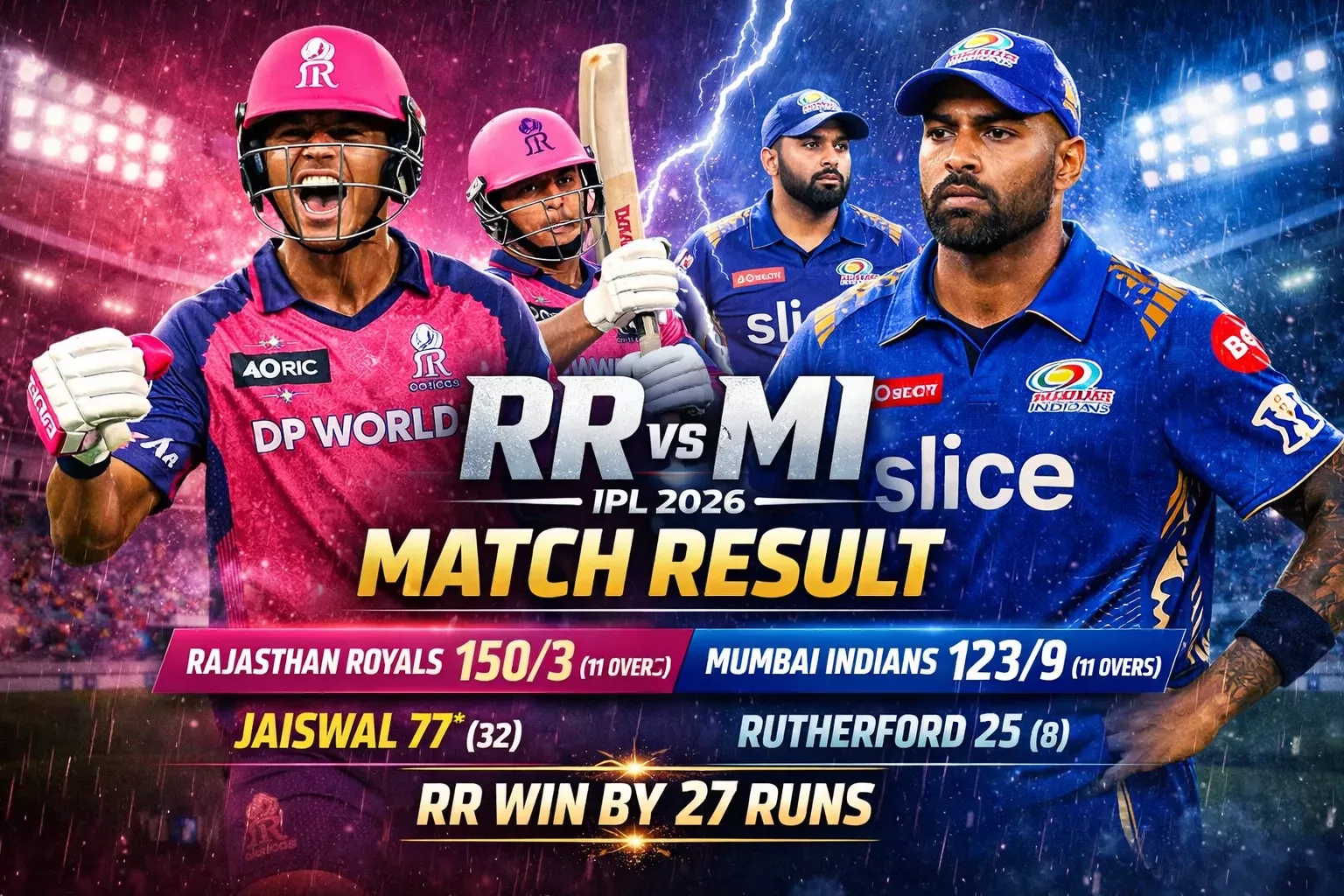
Rajasthan Royals beat Mumbai Indians by 27 runs in Match 13 of IPL 2026 after a rain-hit contest in Guwahati was reduced to 11 overs per side. RR blasted 150/3 after being sent in, then held MI to 123/9 to complete a third win in three matches. The result also sent Rajasthan to the top of the table with 6 points and a net run rate of +2.403, while Mumbai slipped to seventh at 1 win from 3 games.
| Team | Score | Key performers |
|---|---|---|
| Rajasthan Royals | 150/3 in 11 overs | Yashasvi Jaiswal 77* (32), Vaibhav Sooryavanshi 39 (14), Riyan Parag 20 (10) |
| Mumbai Indians | 123/9 in 11 overs | Naman Dhir 25 (13), Sherfane Rutherford 25 (8) |
| Main bowlers | — | RR: Nandre Burger 2/21, Ravi Bishnoi 2/25, Sandeep Sharma 2/26; MI: AM Ghazanfar 2/21 |
These figures come from the final scorecard and match coverage.
The weather reduced this game to a sprint, but Rajasthan understood the format faster than Mumbai. Hardik Pandya won the toss and chose to field first, yet MI never gained control of the powerplay. RR’s openers treated the first few overs as a finishing burst rather than an opening phase, and that shift in intent defined the night.
Yashasvi Jaiswal and Vaibhav Sooryavanshi detonated from ball one. Indian Express recorded that Rajasthan reached 50 in just 2.4 overs, equalling their fastest team fifty in IPL history and standing as the joint-second quickest fifty ever in the tournament. The same report noted that Sooryavanshi, still only 15, launched Jasprit Bumrah for a six off the first ball he faced. That moment was not just theater; it told Mumbai that Rajasthan would not spend a single over “settling in.”
By the end of the 20-ball powerplay, RR were already 59/0. The opening stand reached 80 in only five overs before Shardul Thakur removed Sooryavanshi for 39 off 14 balls. Jaiswal, meanwhile, kept going and finished unbeaten on 77 from 32 deliveries, an innings loaded with 10 fours and 4 sixes. In a shortened game, that is not just a good knock. It is match-shaping violence.
The rare quality in Jaiswal’s innings was balance. Sooryavanshi supplied the chaos at the top, but Jaiswal supplied the structure. He hit early boundaries off Deepak Chahar, rode the pace, kept the field scattered, and then finished the innings with enough control to prevent Mumbai from clawing anything back late. RR still scored 18 in the final over, which turned a very good total into a brutal one.
He was correctly named Player of the Match. The official match details in the final scorecard list Jaiswal as the award winner, and that decision was straightforward: he batted through the innings, scored more than half the team total, and controlled the tempo from the first over to the last.
Mumbai’s attack looked caught between plans. In an 11-over match, there is almost no room for exploratory overs, but MI bowled as if they still had time to recover. Deepak Chahar went for 22 in one over. Trent Boult went for 22 in one. Shardul Thakur conceded 36 in two. Even Bumrah, usually the stabilizer in broken games, ended wicketless again and finished with 0/32 from his 3 overs. Only AM Ghazanfar emerged with numbers that looked truly under control: 2/21 from 2 overs.
That distribution matters. Mumbai did eventually pull things back in the middle when Ghazanfar removed Dhruv Jurel and Riyan Parag, but by then the damage was already loaded into the equation. Once RR were 80/0 after five overs, 150 became reachable even without a late all-out assault. MI were chasing the innings, not controlling it.
The chase never settled. Ryan Rickelton fell in the first over. Suryakumar Yadav was gone by 1.4 overs. Rohit Sharma departed at 2.3. Hardik Pandya followed at 4.3, and Tilak Varma was out by the end of the fifth over. At 46/5, the contest was functionally over unless one batter produced something absurd.
Mumbai did have late counterpunches. Naman Dhir made 25 from 13, and Sherfane Rutherford struck 25 from only 8 balls. Those numbers helped MI avoid a collapse that would have looked uglier on paper, but they never altered the direction of the game. RR’s bowlers had already broken the spine of the chase by removing the top order inside the first half of the innings.
This was the exact opposite of Rajasthan’s batting effort. RR built around one dominant partnership and one dominant innings. MI offered scattered cameos. In shortened cricket, scattered cameos almost never beat one sustained surge.
Rajasthan did not need one bowler to run through Mumbai. They needed discipline across phases, and they got it. Jofra Archer struck in the first over. Nandre Burger removed Suryakumar Yadav and Naman Dhir. Ravi Bishnoi dismissed Hardik Pandya and Tilak Varma. Sandeep Sharma took Rohit Sharma and Shardul Thakur. That spread of wickets prevented Mumbai from forming even a temporary platform.
The larger tactical point is simple: RR adapted better to the surface after the hard new ball phase. Indian Express’ commentary notes that the ball traveled early but that slower deliveries began gripping once it softened. Rajasthan’s bowlers adjusted to that shift; Mumbai’s batters never fully did.
Most scorecards will say Rajasthan won by 27 runs. That is true, but it can hide the deeper truth. The real separation was not 27 runs at the end. It was the difference in how the teams interpreted the first three overs.
RR treated the powerplay like a one-over batting bonus repeated three times. MI treated it like a conventional T20 beginning. That is why Rajasthan had 59 without loss in the powerplay, while Mumbai were already repairing damage before their middle overs even began. In a game shortened to 11 overs, that difference is decisive.
Sooryavanshi’s cameo symbolized that gap in intent. Jaiswal’s unbeaten 77 symbolized the class gap. Rajasthan had both youth and control in the same innings. Mumbai had neither with the new ball and very little with the new bat.