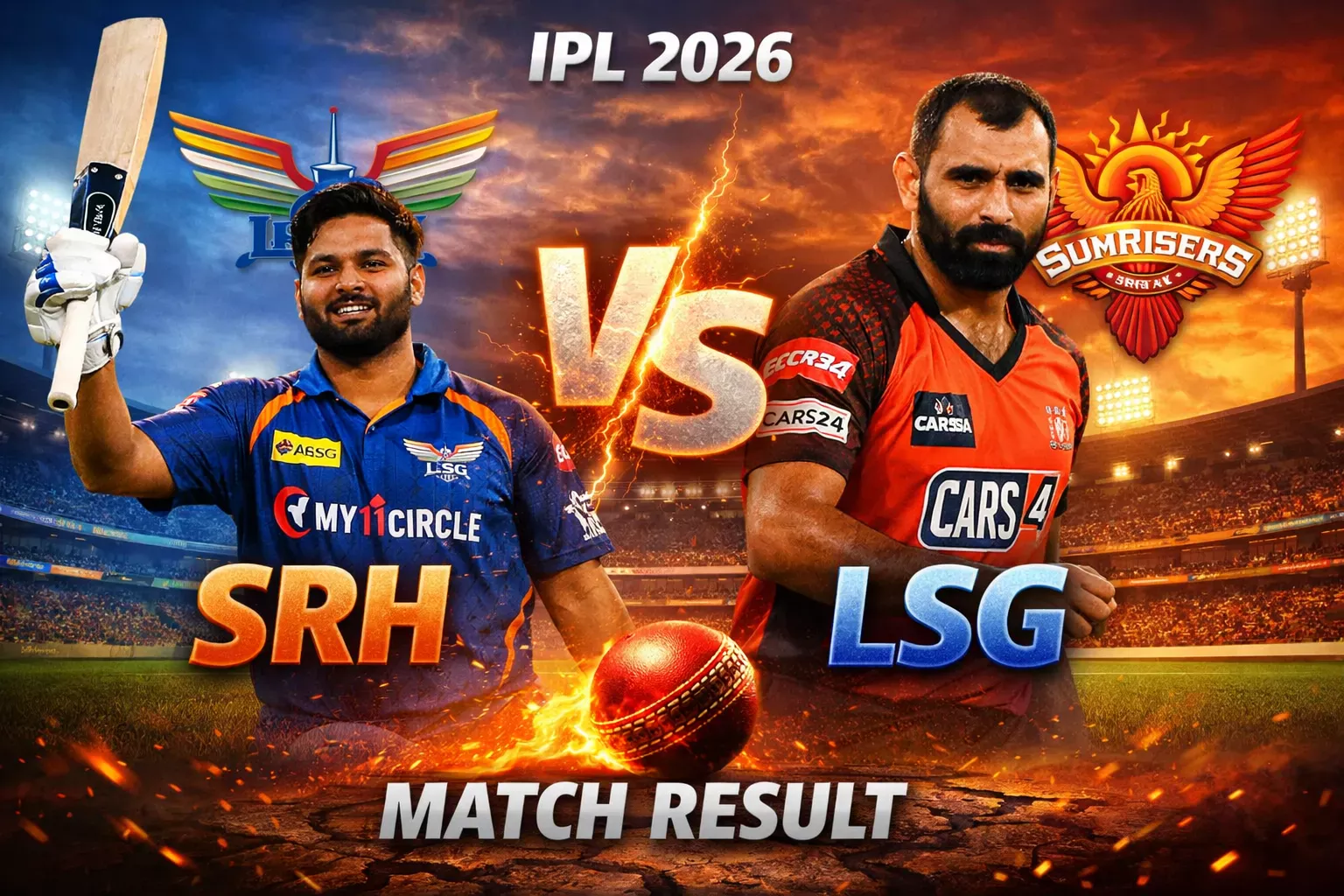
SRH vs LSG Match Result
Table of contents Show
Based on the source list provided in the attached file , Lucknow Super Giants defeated Sunrisers Hyderabad by 5 wickets in Match 10 of IPL 2026 at the Rajiv Gandhi International Stadium, Hyderabad. SRH made 156/9 in 20 overs, and LSG chased it down with 160/5 in 19.5 overs. LSG won the toss, chose to field, and built the result through an elite new-ball spell from Mohammad Shami and a composed chase led by Rishabh Pant.
This was not a routine chase. It was a match split into sharp phases. LSG dominated the first half with the ball, lost control when Heinrich Klaasen and Nitish Kumar Reddy counterattacked, then recovered at the death. In the chase, Aiden Markram gave momentum, Pant gave control, and SRH’s late squeeze was not enough to overturn the damage done earlier.
Result: Lucknow Super Giants beat Sunrisers Hyderabad by 5 wickets
Venue: Rajiv Gandhi International Stadium, Hyderabad
SRH: 156/9 (20 overs)
LSG: 160/5 (19.5 overs)
Player of the Match: Mohammad Shami – 2/9 in 4 overs
Sunrisers Hyderabad began disastrously. Mohammad Shami removed Abhishek Sharma for a duck and then dismissed Travis Head for 7, while Prince Yadav sent back Ishan Kishan for 1. That left SRH at 11/3 inside the first four overs. When Liam Livingstone fell for 14, the innings was in severe trouble at 26/4, and at the 10-over mark SRH were only 35/4, the lowest 10-over score by any team this IPL season according to the official match report.
At that point, Klaasen and Nitish Kumar Reddy produced the innings that kept SRH alive. Klaasen made 62 from 41 balls with 5 fours and 2 sixes, while Reddy struck 56 from 33 with 3 fours and 5 sixes. Together they added 116 runs for the fifth wicket, a new franchise record for SRH in that position. Between overs 14 and 18, they turned a failing innings into a defendable total and restored pressure on LSG.
The problem for Hyderabad was the finish. Once Manimaran Siddharth dismissed Reddy in the 18th over, the innings broke again. Klaasen fell soon after, Harsh Dubey was out for 0, and SRH lost five wickets for 22 runs across the final three overs to close at 156/9. For a side that had rebuilt from 35/4, that ending felt significantly under par. The lower order could not convert recovery into late-over damage.
Mohammad Shami was the defining bowler of the game. His figures of 4-0-9-2 were exceptional in context, not just because of the wickets, but because he removed two of SRH’s most dangerous left-hand powerplay hitters and gave the innings a broken structure from the outset. NDTV and the official IPL report both frame that spell as the foundation of the result, and he was named Player of the Match.
The support bowling mattered as much as the headline figures. Prince Yadav finished with 2/34, Avesh Khan took 2/36, and Siddharth delivered a timely wicket with 1/29. Digvesh Singh’s 1/46 looks expensive, but he did remove Livingstone at a critical point, with Pant taking an outstanding catch. The broader point is that LSG’s attack hit at the right times: early, at the end of the Klaasen-Reddy stand, and again in the death overs.
Chasing 157, LSG made the better start. Mitchell Marsh hit 14, but Aiden Markram drove the innings forward with 45 from 27 balls, including 6 fours and 2 sixes. LSG reached 53/1 in the powerplay compared to SRH’s 22/3, and that gap in early control shaped the chase. Hyderabad were always trying to recover territory they had already lost.
After Markram fell, the chase became less fluent. Ayush Badoni made 12, Nicholas Pooran was run out for 1, and Abdul Samad added 16. SRH briefly re-entered the contest when Harsh Dubey bowled tightly and picked up two wickets for 18 in 4 overs. By the 15-over strategic timeout, LSG were 114/4, and the match had narrowed.
But Pant played the innings SRH could not stop. He remained unbeaten on 68 from 50 balls with 9 fours, paced the chase well, reached his fifty in 43 balls, and stayed calm when the asking rate threatened to rise late. In the final over, with 9 needed, Pant hit three boundaries off Jaydev Unadkat and finished the match with one ball left. This was not a brutal innings. It was a controlled captain’s knock built on game awareness.
The first turning point came in the opening overs, when Shami removed Abhishek Sharma and Travis Head, and Prince Yadav dismissed Ishan Kishan. SRH’s top order never rebuilt its original plan after that sequence.
The second turning point was the fifth-wicket partnership between Klaasen and Nitish Kumar Reddy. Without that stand, this could have become a one-sided collapse. Their counterattack gave SRH a total and temporarily flipped the pressure.
The third turning point was the death bowling from LSG. SRH moved from 142/4 to 156/9, which meant the final total lacked the cushion that looked possible only minutes earlier.
The fourth turning point was Pant’s finish. SRH dragged the game deep, but once the final over began, Pant removed uncertainty immediately. That ended any realistic chance of a late Hyderabad steal.
SRH lost because their top order collapsed too early and their finish collapsed too late. The middle rescued them, but the structure of the innings remained unstable. Scores of 0, 7, 1, and 14 from four of the first five batters put too much pressure on Klaasen and Reddy. Then, after the recovery, the innings closed weakly. Against a well-drilled chase, 156 was not enough.
There was also a tactical difference in powerplay quality. LSG extracted value immediately with the ball and then with the bat. SRH were 22/3 after six overs; LSG were 53/1. In T20 cricket, that kind of contrast usually decides the direction of the game before the finish even arrives.
LSG won because they were better in the decisive phases. They won the toss and used the new ball correctly. Their seam attack destabilized the top order. Their fielding contributed, especially through Pant behind the stumps. Then, in the chase, Markram attacked, Pant absorbed pressure, and the lower middle order did just enough to support the captain.
This was also an important psychological result for Lucknow. The official IPL report notes that it was LSG’s first win of the new season, and it came in a game where they had to recover twice: once after Klaasen and Reddy’s partnership, and once again when SRH tightened the chase late. That makes the result more valuable than a simple five-wicket margin suggests.