Views: 568
INTRO
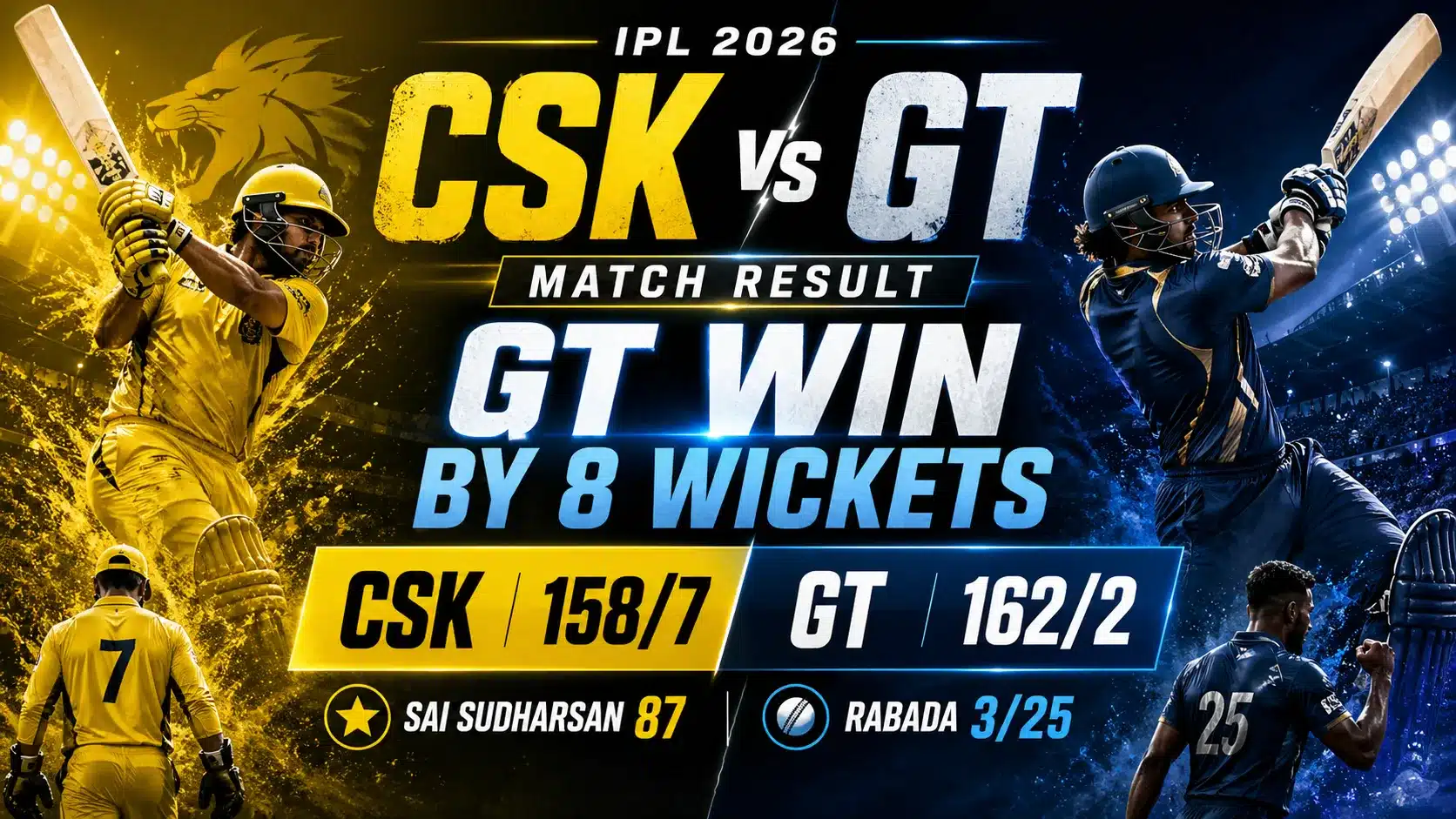
Gujarat Titans delivered a clinical away performance against Chennai Super Kings in Match 37 of IPL 2026, beating CSK by 8 wickets at the MA Chidambaram Stadium in Chennai. CSK made only 158/7 in 20 overs, and GT chased the target down with ease, reaching 162/2 in 16.4 overs. The match was decided by two clear factors: Gujarat’s seamers destroyed CSK’s top order early, and Sai Sudharsan then controlled the chase with a brilliant 87 off 46 balls.
Match snapshot 📊
| Category | Details |
|---|---|
| Match | Chennai Super Kings vs Gujarat Titans, Match 37 |
| Tournament | IPL 2026 |
| Venue | MA Chidambaram Stadium, Chennai |
| Date | April 26, 2026 |
| Toss | Gujarat Titans won the toss and chose to bowl |
| CSK score | 158/7 in 20 overs |
| GT score | 162/2 in 16.4 overs |
| Result | Gujarat Titans won by 8 wickets |
| Balls remaining | 20 balls |
| Player of the Match | Kagiso Rabada |
| Top CSK scorer | Ruturaj Gaikwad — 74* off 60 |
| Top GT scorer | Sai Sudharsan — 87 off 46 |
| Best GT bowler | Kagiso Rabada — 3/25 |
| Best CSK bowler | Noor Ahmad — 1/29 |
The official IPL report described Gujarat’s chase as “flawless,” while Cricbuzz confirmed the full scoreline: CSK 158/7, GT 162/2, with Gujarat winning by eight wickets.
First innings: CSK collapsed early and never fully recovered ⚠️
Gujarat captain Shubman Gill won the toss and chose to field, and the decision worked immediately. The Chepauk surface offered early assistance to seamers, and GT’s quick bowlers used it properly. CSK were pushed into trouble inside the powerplay, reaching only 28 runs in the first six overs. That slow start set the tone for the entire innings.
The top order never gave Chennai the platform they needed. Sanju Samson made 11 off 15, Urvil Patel scored 4 off 3, Sarfaraz Khan fell for 0 off 1, and Dewald Brevis struggled badly for 2 off 9. By 8.2 overs, CSK were already 37/4, which forced Ruturaj Gaikwad into damage-control mode instead of allowing him to build a normal T20 innings.
CSK batting card 🟡
| CSK batter | Runs | Balls | 4s | 6s | Strike rate |
|---|---|---|---|---|---|
| Sanju Samson | 11 | 15 | 2 | 0 | 73.33 |
| Ruturaj Gaikwad | 74* | 60 | 6 | 4 | 123.33 |
| Urvil Patel | 4 | 3 | 1 | 0 | 133.33 |
| Sarfaraz Khan | 0 | 1 | 0 | 0 | 0.00 |
| Dewald Brevis | 2 | 9 | 0 | 0 | 22.22 |
| Shivam Dube | 22 | 17 | 3 | 1 | 129.41 |
| Kartik Sharma | 15 | 9 | 3 | 0 | 166.67 |
| Jamie Overton | 18 | 6 | 3 | 1 | 300.00 |
| Akeal Hosein | 0* | 0 | 0 | 0 | — |
| Extras | 12 | — | — | — | — |
| Total | 158/7 | 20 overs | — | — | 7.90 RPO |
Ruturaj Gaikwad’s unbeaten 74 off 60 was the only major CSK innings, but it was also a conflicted knock. He held the innings together after the collapse, yet his scoring tempo remained too slow for a modern IPL total. Cricbuzz’s post-match note pointed out that CSK had little to celebrate beyond Gaikwad spending time in the middle and reaching fifty.
Ruturaj’s lone fight: useful survival, limited damage 🧱
Gaikwad’s innings had two sides. On one side, he prevented CSK from being bowled out cheaply. On the other side, 74 off 60 at a strike rate of 123.33 did not create enough pressure on Gujarat. In the first 12 overs, Chennai lacked boundary tempo, and by the time the lower order tried to accelerate, the total ceiling was already reduced.
The best partnership for CSK was the 59-run stand between Ruturaj Gaikwad and Shivam Dube. Dube made 22 off 17, but he fell at 96/5 in 15.3 overs, just when Chennai needed a proper death-overs launch. Kartik Sharma then added 15 off 9, while Jamie Overton’s 18 off 6 gave CSK a late push. Still, 158 remained below par against GT’s batting lineup.
CSK partnerships
| Partnership | Runs | Balls | Meaning |
|---|---|---|---|
| Samson + Gaikwad | 21 | 21 | Slow start under seam pressure |
| Urvil + Gaikwad | 4 | 3 | Brief phase before another wicket |
| Sarfaraz + Gaikwad | 1 | 4 | GT tightened control |
| Brevis + Gaikwad | 11 | 22 | Chennai lost momentum badly |
| Dube + Gaikwad | 59 | 43 | Main recovery phase |
| Kartik + Gaikwad | 26 | 14 | Late acceleration attempt |
| Overton + Gaikwad | 21 | 7 | Final burst before Overton fell |
| Hosein + Gaikwad | 15 | 6 | Last few runs |
The innings pattern was obvious: one anchor, one decent recovery stand, then scattered lower-order hits. That was not enough to challenge Gujarat.
GT bowling: Rabada and Siraj broke the innings early 🎯
Kagiso Rabada was the most influential bowler of the match. He dismissed Sanju Samson, Urvil Patel, and Kartik Sharma, finishing with 3/25 in 4 overs. The official IPL report highlighted Rabada’s fiery, precise spell, and Cricbuzz named him Player of the Match.
Mohammed Siraj also played a major role by keeping the pressure high with the new ball. He finished with 1/23 in 4 overs, while Jason Holder gave away only 22 runs in 4 overs despite not taking a wicket. Gujarat’s attack did not just take wickets; it also prevented CSK from finding rhythm for long stretches.
GT bowling figures
| GT bowler | Overs | Runs | Wickets | Economy |
|---|---|---|---|---|
| Mohammed Siraj | 4 | 23 | 1 | 5.80 |
| Kagiso Rabada | 4 | 25 | 3 | 6.20 |
| Manav Suthar | 3 | 22 | 1 | 7.30 |
| Jason Holder | 4 | 22 | 0 | 5.50 |
| Arshad Khan | 4 | 43 | 2 | 10.80 |
| Rashid Khan | 1 | 21 | 0 | 21.00 |
Rabada, Siraj, Holder, and Manav Suthar gave GT control for most of the innings. Arshad Khan was expensive, but he still took two wickets, removing Shivam Dube and Jamie Overton. Rashid Khan bowled only one over and conceded 21, but GT had already done enough through pace and discipline.
CSK innings phase breakdown 📉
| Phase | CSK score | Reading |
|---|---|---|
| Powerplay | 28/3 | Match-damaging collapse |
| Overs 7–15 | 61/1 | Gaikwad and Dube rebuilt slowly |
| Overs 16–20 | 69/3 | Late runs came, but too late |
| Final total | 158/7 | Respectable, not competitive |
The powerplay was the real damage. CSK scored only 28 and lost three wickets. On a pitch where timing was difficult, wickets mattered even more than raw run rate. Once Chennai lost the top order, they never had enough batting depth left to reach 175-plus.
GT chase: Sai Sudharsan made 159 look small 🔥
Gujarat’s chase began with complete authority. Shubman Gill and Sai Sudharsan scored 55/0 in the powerplay, nearly double CSK’s powerplay output. That one comparison explains the match: CSK were struggling to survive; GT were already controlling the chase.
Gill made 33 off 23, hitting one four and three sixes, before Noor Ahmad drew him out of his crease and Sanju Samson completed a sharp stumping. The official IPL report described that stumping as CSK’s lone moment of magic in the chase. But by then GT were 58/1 in 6.2 overs, already well ahead of the required rate.
GT batting card 🔵
| GT batter | Runs | Balls | 4s | 6s | Strike rate |
|---|---|---|---|---|---|
| Sai Sudharsan | 87 | 46 | 4 | 7 | 189.13 |
| Shubman Gill | 33 | 23 | 1 | 3 | 143.48 |
| Jos Buttler | 39* | 30 | 4 | 1 | 130.00 |
| Washington Sundar | 1* | 1 | 0 | 0 | 100.00 |
| Extras | 2 | — | — | — | — |
| Total | 162/2 | 16.4 overs | — | — | 9.72 RPO |
Sai Sudharsan’s 87 off 46 was the chase-defining innings. He hit 4 fours and 7 sixes, scoring at 189.13, and made sure CSK never built pressure after the powerplay. His wicket came at 155/2 in 16.2 overs, when the game was already finished in practical terms.
Sudharsan and Buttler closed the door 🧠
After Gill’s wicket, Sudharsan and Jos Buttler added 97 runs in 60 balls. That partnership removed any possible CSK comeback. Buttler did not need to attack recklessly; his 39 off 30* was controlled, mature, and exactly suited to the chase. Sudharsan remained the aggressor, while Buttler ensured there was no collapse.
GT partnerships
| Partnership | Runs | Balls | Meaning |
|---|---|---|---|
| Sudharsan + Gill | 58 | 39 | Won the powerplay and killed early pressure |
| Sudharsan + Buttler | 97 | 60 | Match-winning stand |
| Buttler + Washington Sundar | 7* | 2 | Formal finish |
GT’s chase was not chaotic. It was clean and measured. They scored fast enough early, then controlled the middle overs without allowing CSK any meaningful window back into the match.
CSK bowling: no sustained pressure after the first wicket
CSK’s bowling card reflects a side that never defended a strong enough score. Noor Ahmad was the most efficient bowler, taking 1/29 in 4 overs. Anshul Kamboj also kept things tight with 0/16 in 3 overs. But Akeal Hosein went for 46 in 3.4 overs, Gurjapneet Singh conceded 36 in 3, and Jamie Overton went for 28 in 2. That made the target too easy for Gujarat.
CSK bowling figures
| CSK bowler | Overs | Runs | Wickets | Economy |
|---|---|---|---|---|
| Akeal Hosein | 3.4 | 46 | 1 | 12.50 |
| Anshul Kamboj | 3 | 16 | 0 | 5.30 |
| Jamie Overton | 2 | 28 | 0 | 14.00 |
| Gurjapneet Singh | 3 | 36 | 0 | 12.00 |
| Noor Ahmad | 4 | 29 | 1 | 7.20 |
| Shivam Dube | 1 | 7 | 0 | 7.00 |
Chennai needed wickets in clusters. Instead, they got only two wickets in the entire chase, and both came when GT were already in control. A target of 159 left almost no margin for expensive overs.
Key turning points ⚡
| Phase | What happened | Why it mattered |
|---|---|---|
| GT chose to bowl | Gill used early seam help | Correct tactical call |
| CSK powerplay | 28/3 | Chennai lost the match shape early |
| Rabada spell | 3/25 | Broke CSK’s batting structure |
| Gaikwad anchor | 74* off 60 | Saved CSK from collapse, but lacked tempo |
| Overton cameo | 18 off 6 | Lifted CSK to 158 |
| GT powerplay | 55/0 | Gujarat took full control of the chase |
| Gill-Sudharsan stand | 58 in 39 balls | Removed early pressure |
| Sudharsan-Buttler stand | 97 in 60 balls | Finished the contest |
| Final result | GT won by 8 wickets | Dominant away win |
Tactical reading: why Gujarat Titans won 🧩
Gujarat won because they dominated both powerplays. CSK made 28/3 in their first six overs. GT made 55/0 in theirs. That 27-run gap and three-wicket difference effectively decided the match before the halfway point of the chase.
The second reason was Gujarat’s seam-bowling structure. Rabada, Siraj, and Holder gave nothing easy early. CSK’s batters were forced into defensive cricket, and even Gaikwad’s unbeaten 74 could not change the innings tempo enough.
The third reason was Sai Sudharsan’s clarity. He did not let Chennai’s spinners settle. He attacked length, used the powerplay base well, and turned the chase from “gettable” into “routine.” His innings of 87 off 46 was the most decisive batting contribution of the night.
What the result means 📈
Cricbuzz reported that Gujarat climbed to fifth spot with this result, while CSK were left with little positive beyond Gaikwad’s time at the crease. For GT, the win was important because Rabada’s form, Sudharsan’s consistency, and the team’s fast-bowling depth all clicked together in one match.
For CSK, the defeat exposed a recurring problem: when their top order collapses, the innings becomes too dependent on one batter anchoring. On this night, that batter was Gaikwad, but his tempo could not compensate for the early wickets. Chennai needed a 175-type total. They got 158.
Final verdict 🏁
Gujarat Titans beat Chennai Super Kings because they were sharper in every important phase. Rabada and Siraj damaged CSK early, Holder and Suthar kept the middle quiet, and Sai Sudharsan turned the chase into a controlled exhibition. CSK had Gaikwad’s resistance and Overton’s late burst, but they never escaped the damage of 28/3 in the powerplay. GT’s 8-wicket win with 20 balls left was not a tight chase. It was a disciplined demolition.
Author

Ernest Shpilevoy
Author