Views: 694
INTRO
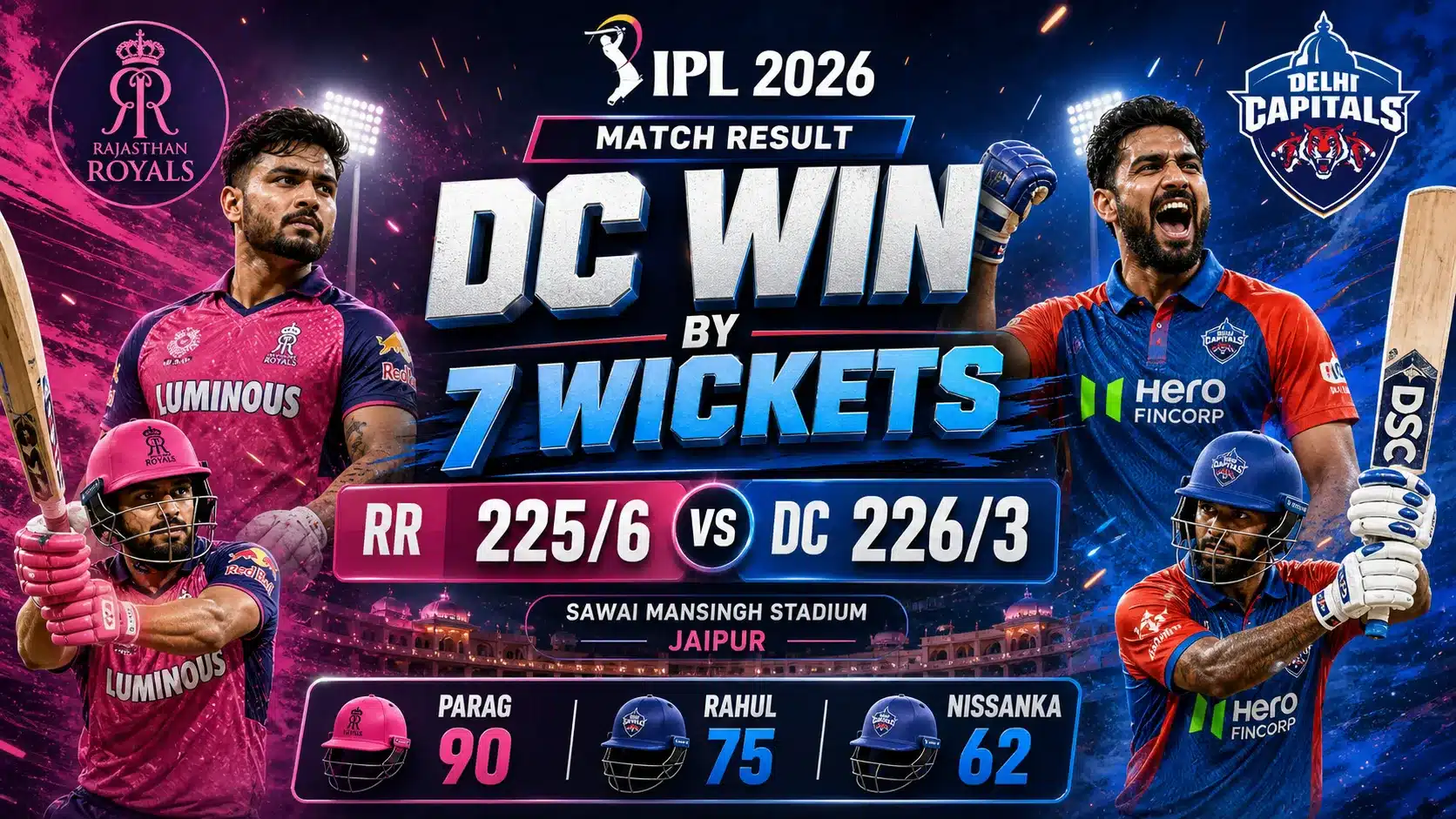
Delhi Capitals produced their highest successful run chase in IPL history, beating Rajasthan Royals by 7 wickets with 5 balls remaining at the Sawai Mansingh Stadium in Jaipur. RR posted a strong 225/6 in 20 overs, driven by Riyan Parag’s 90 off 50 balls and Donovan Ferreira’s 47 off 14*, but DC answered with 226/3 in 19.1 overs through a brilliant top-order chase led by KL Rahul’s 75 off 40 and Pathum Nissanka’s 62 off 33. The official IPL report described the chase as a batting masterclass and confirmed that the match produced 451 total runs.
Match Snapshot 📊
| Category | Details |
|---|---|
| Match | Rajasthan Royals vs Delhi Capitals, Match 43 |
| Tournament | IPL 2026 |
| Venue | Sawai Mansingh Stadium, Jaipur |
| Date | May 1, 2026 |
| Toss | Rajasthan Royals won the toss and chose to bat |
| RR score | 225/6 in 20 overs |
| DC score | 226/3 in 19.1 overs |
| Result | Delhi Capitals won by 7 wickets |
| Balls remaining | 5 |
| Player of the Match | KL Rahul |
| Top RR scorer | Riyan Parag — 90 off 50 |
| Top DC scorer | KL Rahul — 75 off 40 |
| Key DC support | Pathum Nissanka — 62 off 33 |
| Best DC bowler | Mitchell Starc — 3/40 |
| Best RR bowler | Jofra Archer — 1/46 |
ESPN’s scorecard confirms the final scoreline, venue, toss, Player of the Match, and points allocation: Delhi Capitals 2, Rajasthan Royals 0.
RR Innings: Early Collapse, Parag Rescue, Ferreira Explosion 💥
Rajasthan Royals started aggressively, but the first two overs damaged their structure. Yashasvi Jaiswal hit the first ball of the match for six, but Mitchell Starc removed him in the same over. Kyle Jamieson then bowled Vaibhav Sooryavanshi with an inswinging yorker, leaving RR in trouble at 12/2. The official IPL report framed this phase as early peril for Rajasthan after two quick new-ball strikes.
That collapse forced Rajasthan into a rebuild. Riyan Parag and Dhruv Jurel responded with a crucial 102-run partnership, turning 12/2 into 114/3. Jurel played the support role with 42 off 30, while Parag controlled the innings with power and timing. Parag reached his fifty from 32 balls, then continued to attack through the middle overs.
Parag’s innings was the backbone of RR’s total. He scored 90 off 50 balls, with 8 fours and 5 sixes, striking at 180.00. This was not a loose slog. It was a structured counterattack after early wickets, and it gave Rajasthan the base for a 220-plus score.
RR Batting Card 🧾
| RR Batter | Runs | Balls | 4s | 6s | Strike Rate |
|---|---|---|---|---|---|
| Yashasvi Jaiswal | 6 | 3 | 0 | 1 | 200.00 |
| Vaibhav Sooryavanshi | 4 | 2 | 1 | 0 | 200.00 |
| Dhruv Jurel | 42 | 30 | 4 | 1 | 140.00 |
| Riyan Parag | 90 | 50 | 8 | 5 | 180.00 |
| Ravindra Jadeja | 20 | 14 | 1 | 1 | 142.86 |
| Donovan Ferreira | 47* | 14 | 2 | 6 | 335.71 |
| Shubham Dubey | 6 | 6 | 1 | 0 | 100.00 |
| Jofra Archer | 1* | 1 | 0 | 0 | 100.00 |
| Extras | 9 | — | — | — | — |
| Total | 225/6 | 20 overs | — | — | 11.25 RPO |
Cricbuzz’s scorecard confirms Rajasthan’s full batting card and fall of wickets: 6/1, 12/2, 114/3, 167/4, 168/5, 208/6.
Parag-Jurel Stand: The Innings Reset 🧠
The key recovery phase was the 102-run third-wicket stand between Parag and Jurel. Rajasthan were vulnerable at 12/2, but this partnership restored the innings completely. Jurel contributed 40 runs in the partnership, while Parag contributed 61, showing the clear division of roles: Jurel stabilized, Parag attacked.
| Partnership | Runs | Balls | Impact |
|---|---|---|---|
| Jaiswal + Sooryavanshi | 6 | 3 | Short, aggressive start |
| Sooryavanshi + Jurel | 6 | 8 | Ended by Jamieson |
| Jurel + Parag | 102 | 59 | Rebuilt RR innings |
| Parag + Jadeja | 53 | 28 | Took RR toward 170 |
| Parag + Ferreira | 1 | 2 | Broken by Starc |
| Ferreira + Dubey | 40 | 15 | Late acceleration |
| Ferreira + Archer | 17 | 5 | Final push |
Parag and Jadeja then added 53 off 28 balls, but Mitchell Starc’s return in the 17th over changed the innings again. Starc removed Jadeja and Parag in a double strike, briefly pulling Delhi back into the contest.
Donovan Ferreira’s Death-Overs Assault 🚀
Just when Delhi looked ready to contain Rajasthan below 210, Donovan Ferreira changed the final phase. He hammered 47 not out off 14 balls, with 2 fours and 6 sixes, striking at 335.71. The IPL report states that RR scored 63 runs in the final four overs, with Ferreira’s hitting pushing the total to 225/6.
Ferreira’s cameo was the reason Rajasthan crossed 220. Without his late assault, Parag’s 90 would have produced a strong but not intimidating total. With Ferreira, Rajasthan had a target that should have created scoreboard pressure.
DC Bowling: Starc’s Return Gave Delhi Early and Late Control 🎯
Mitchell Starc was Delhi’s most important bowler. He struck in the first over to remove Jaiswal, then returned in the death overs to dismiss Jadeja and Parag. His 3/40 was the best bowling return of the match, and Rajasthan’s own report noted that he marked his return to the DC lineup with match-best figures.
Kyle Jamieson gave Delhi the second early strike by bowling Sooryavanshi, while Axar Patel dismissed Jurel. T Natarajan removed Shubham Dubey late but was expensive, conceding 54 in his four overs.
DC Bowling Figures
| DC Bowler | Overs | Runs | Wickets | Economy |
|---|---|---|---|---|
| Mitchell Starc | 4 | 40 | 3 | 10.00 |
| Kyle Jamieson | 4 | 48 | 1 | 12.00 |
| Axar Patel | 4 | 39 | 1 | 9.80 |
| Kuldeep Yadav | 4 | 41 | 0 | 10.20 |
| T Natarajan | 4 | 54 | 1 | 13.50 |
Delhi did not bowl economically as a unit, but Starc’s wickets prevented RR from reaching 240. That mattered because DC eventually won with only five balls left.
RR Innings Phase Breakdown ⚡
| Phase | RR Score | Reading |
|---|---|---|
| Powerplay | 56/2 | Fast but damaged by early wickets |
| Overs 7–14 | 74/1 | Parag-Jurel rebuilt properly |
| Overs 15–20 | 95/3 | Ferreira turned the finish into a surge |
| Final total | 225/6 | Strong, but not enough on this surface |
Rajasthan did enough with the bat to win many matches. The issue was not the first innings alone. The issue was that Delhi’s top order made the chase look controlled rather than desperate.
DC Chase: Rahul and Nissanka Destroy the Target Early 🔥
Chasing 226, Delhi needed a high-tempo start. KL Rahul and Pathum Nissanka delivered exactly that. DC reached 70/0 in the powerplay, then crossed 100 in 8.4 overs. The opening pair added 110 runs, instantly removing the pressure of a 226 target.
Nissanka was the early aggressor. He scored 62 off 33 balls, hitting 6 fours and 3 sixes, and reached his maiden IPL fifty off 23 balls. The official IPL report said he took on the primary attacking role in the opening partnership.
Rahul played the match-winning innings. He made 75 off 40 balls, with 6 fours and 5 sixes, striking at 187.50. Reuters reported that Rahul’s knock took him to the top of the IPL run-scoring charts and helped Delhi complete their highest successful IPL chase.
DC Batting Card 🧾
| DC Batter | Runs | Balls | 4s | 6s | Strike Rate |
|---|---|---|---|---|---|
| Pathum Nissanka | 62 | 33 | 6 | 3 | 187.88 |
| KL Rahul | 75 | 40 | 6 | 5 | 187.50 |
| Nitish Rana | 33 | 17 | 3 | 2 | 194.12 |
| Tristan Stubbs | 18* | 11 | 1 | 1 | 163.64 |
| Ashutosh Sharma | 25* | 15 | 4 | 0 | 166.67 |
| Extras | 13 | — | — | — | — |
| Total | 226/3 | 19.1 overs | — | — | 11.79 RPO |
Cricbuzz confirms DC’s complete batting card and final chase score of 226/3 in 19.1 overs.
Rahul-Nissanka Stand: The Chase Was Won Early 🧩
The opening partnership was the decisive phase of the match. Rahul and Nissanka added 110 runs in 57 balls, with Nissanka contributing 62 and Rahul 47 in that stand. Delhi were 78/0 after 7 overs, then 100/0 after 8.4 overs, meaning RR were already defending a shrinking equation before they found the first wicket.
| DC Partnership | Runs | Balls | Impact |
|---|---|---|---|
| KL Rahul + Pathum Nissanka | 110 | 57 | Broke the chase open |
| KL Rahul + Nitish Rana | 61 | 30 | Kept DC ahead after first wicket |
| KL Rahul + Tristan Stubbs | 6 | 5 | Short phase before Rahul fell |
| Tristan Stubbs + Ashutosh Sharma | 49* | 23 | Finished the chase |
Ravindra Jadeja finally trapped Nissanka lbw at 110/1, but by then Delhi had already reached a dominant position. Nitish Rana then made sure Rajasthan could not build pressure, scoring 33 off 17 and adding 61 with Rahul.
RR Fightback: Archer Removes Rahul, But Too Late ⚠️
Rajasthan did not collapse completely with the ball. Jadeja removed Nissanka, Tushar Deshpande dismissed Nitish Rana, and Jofra Archer got the huge wicket of KL Rahul at 177/3 in 15.2 overs. At that point, DC still needed 49 runs from 28 balls, and RR briefly had two new batters at the crease.
Archer almost created a tense finish. Rajasthan’s report notes that he conceded only five runs from his first five balls in the penultimate over before Tristan Stubbs hit a boundary off the final ball, leaving Delhi needing five from the last over.
But Delhi’s finishing pair handled the pressure. Stubbs stayed unbeaten on 18 off 11, while Ashutosh Sharma scored 25 off 15* and struck four boundaries. The IPL report highlighted their composed finish as the final phase that took DC to 226/3 in 19.1 overs.
RR Bowling Figures 📉
| RR Bowler | Overs | Runs | Wickets | Economy |
|---|---|---|---|---|
| Jofra Archer | 4 | 46 | 1 | 11.50 |
| Nandre Burger | 3 | 41 | 0 | 13.66 |
| Tushar Deshpande | 4 | 38 | 1 | 9.50 |
| Brijesh Sharma | 3.1 | 35 | 0 | 11.05 |
| Ravi Bishnoi | 2 | 28 | 0 | 14.00 |
| Ravindra Jadeja | 3 | 33 | 1 | 11.00 |
The bowling card shows the problem clearly: every RR bowler went above 9.50 runs per over. Even wicket-taking spells could not become pressure spells because Delhi kept finding boundaries.
DC Chase Phase Breakdown 🚀
| Phase | DC Score / Event | Match Meaning |
|---|---|---|
| Powerplay | 70/0 | Perfect launch |
| 8.4 overs | 100 reached | Target pressure reduced |
| 9.3 overs | Nissanka out at 110/1 | RR first breakthrough came late |
| 14.3 overs | Rana out at 171/2 | Still DC advantage |
| 15.2 overs | Rahul out at 177/3 | RR had a short window |
| 19.1 overs | DC 226/3 | Chase completed with 5 balls left |
Delhi won because they never allowed the required rate to become uncomfortable. Even when Rahul fell, Stubbs and Ashutosh needed a fast finish, not a miracle.
Key Turning Points 🔥
| Moment | What Happened | Why It Mattered |
|---|---|---|
| Starc removes Jaiswal | RR lost wicket in first over | Early damage to RR |
| Jamieson bowls Sooryavanshi | RR 12/2 | Delhi took control early |
| Parag-Jurel stand | 102-run partnership | RR rebuilt the innings |
| Parag’s 90 | Captain’s knock under pressure | Took RR toward 200+ |
| Starc double strike | Jadeja and Parag removed | Stopped RR from going bigger |
| Ferreira 47* off 14 | RR reached 225/6 | Made the target imposing |
| DC powerplay 70/0 | Rahul-Nissanka attacked early | Chase pressure disappeared |
| Opening stand 110 | DC controlled required rate | RR lost scoreboard leverage |
| Rahul 75 | Match-winning anchor-aggressor role | DC stayed ahead |
| Stubbs-Ashutosh 49* | Finished chase | DC avoided late collapse |
The biggest turning point was the Delhi powerplay. A target of 226 looks dangerous if the chasing side starts at 45/2. DC started at 70/0, and that changed the entire match.
Records and Context 📚
This was Delhi Capitals’ highest successful chase in IPL history, confirmed by both the official IPL report and Reuters. Reuters also reported that the win snapped Delhi’s three-match losing streak, while Rahul’s 75 pushed him to the top of the tournament run-scoring charts at that stage.
The result placed DC sixth on the table with 8 points from 9 matches, while Rajasthan remained fourth with 12 points from 10 matches, according to ESPN’s points table after the match.
For Rajasthan, this was another painful home defeat after scoring heavily. Their own report stated that their wait for a first Jaipur win in IPL 2026 continued, despite Parag’s 90 and Ferreira’s late hitting.
Tactical Reading: Why DC Won 🧠
Delhi won because they controlled both pressure moments better.
First, they struck early with the ball. RR were 12/2, which forced Parag and Jurel into a rebuild. Rajasthan still reached 225, but they had to spend energy repairing the innings before launching.
Second, Delhi’s chase had the right tempo. Rahul and Nissanka did not merely survive the first six overs; they attacked them. Their 110-run opening stand meant Rajasthan’s bowlers were defending from behind for most of the innings.
Third, DC had enough finishing depth. When Rahul fell, the match still had risk. But Stubbs and Ashutosh added 49 unbeaten runs in 23 balls, which removed the final uncertainty.
Final Verdict 🏁
Rajasthan Royals had a strong total. Delhi Capitals had a stronger chase plan. RR recovered from 12/2 through Riyan Parag’s 90 and Ferreira’s explosive finish, but DC’s opening pair damaged the chase equation immediately. Rahul and Nissanka added 110, Rana kept the tempo alive, and Stubbs plus Ashutosh completed the job.
The scorecard says DC won by 7 wickets with 5 balls remaining. The deeper story is simple: RR scored 225, but DC removed the fear from the chase inside the first six overs.
Tactical Reading: Why SRH Won 🧩
SRH won because they attacked the target with correct sequencing. Head and Abhishek did not “set up” the chase slowly. They cut the required rate immediately by scoring 92 in the powerplay. That forced Mumbai to chase wickets rather than defend runs.
The second tactical reason was Klaasen’s timing. When SRH slipped from 129/0 to 133/3, MI had a chance to create pressure. Klaasen killed that chance by attacking within two overs, not by waiting for the equation to settle.
MI lost because their bowling had no control phase. They had a massive total, but they could not string together two quiet overs after the powerplay. Dropped chances and poor execution made the problem worse, and Hardik’s post-match comments reflected that frustration.
Final Verdict 🏁
Mumbai Indians had the historic individual innings. Sunrisers Hyderabad had the better chase architecture. Ryan Rickelton’s 123* deserved to win many matches, but this one belonged to Travis Head’s powerplay violence, Abhishek Sharma’s support, Heinrich Klaasen’s middle-over control, and Salil Arora’s finishing burst.
The scoreboard says SRH won by 6 wickets. The deeper story is sharper: MI made 243 and still looked second-best once SRH reached 92/0 after six overs.
Author

Ernest Shpilevoy
Author