INTRO
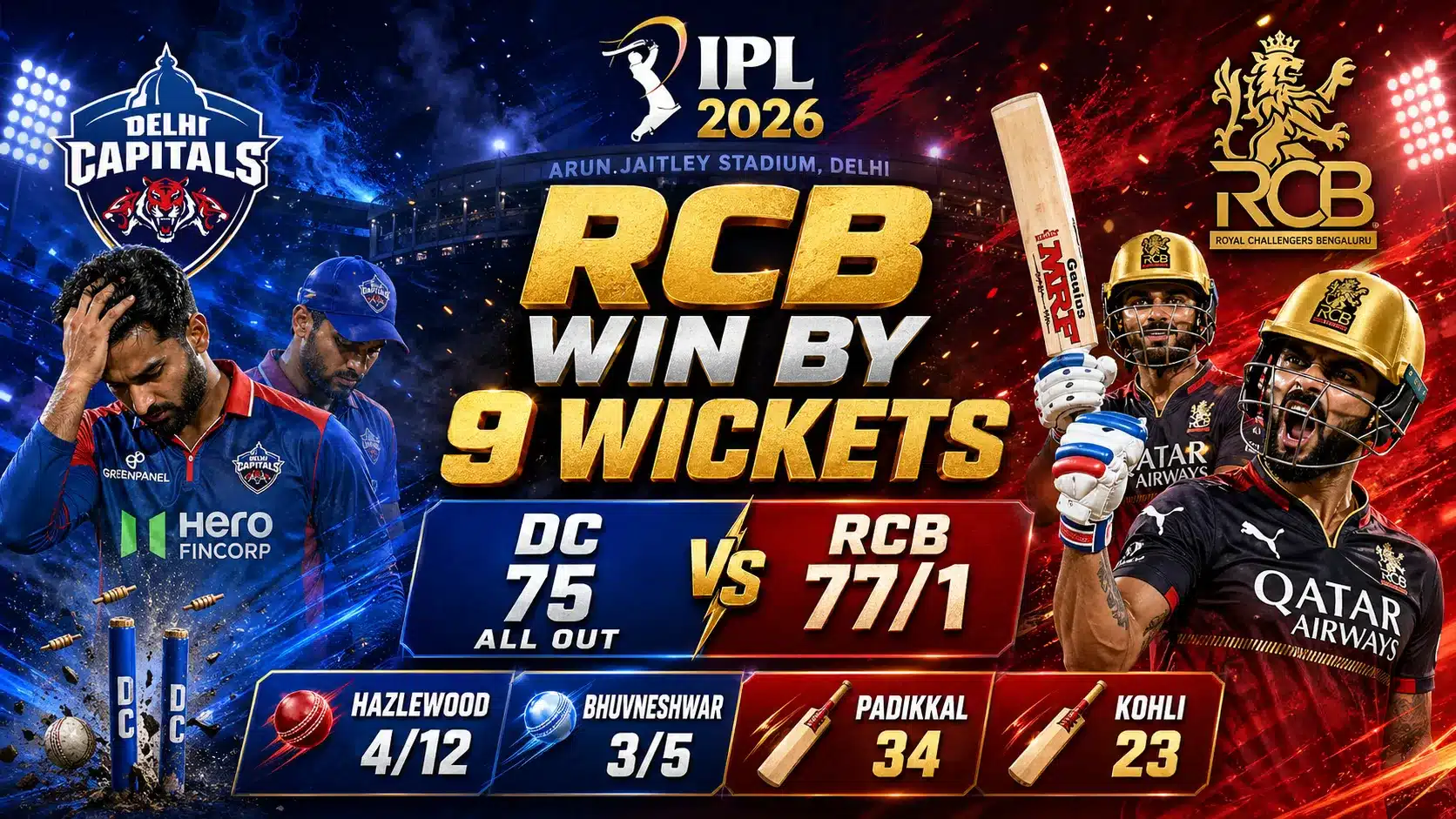
Royal Challengers Bengaluru produced one of the most ruthless bowling performances of IPL 2026, crushing Delhi Capitals by 9 wickets at the Arun Jaitley Stadium. Delhi were bowled out for only 75 in 16.3 overs, and RCB chased the target in just 6.3 overs, finishing at 77/1. The match was effectively decided inside the first four overs, when Josh Hazlewood and Bhuvneshwar Kumar ripped through Delhi’s top order and reduced DC to 8/6. Reuters described the game as a rare bowler-dominated IPL contest, especially striking because the same ground had produced a record 265 chase only two days earlier.
Match snapshot 📊
| Category | Details |
|---|---|
| Match | Delhi Capitals vs Royal Challengers Bengaluru, Match 39 |
| Tournament | IPL 2026 |
| Venue | Arun Jaitley Stadium, Delhi |
| Date | Monday, April 27, 2026 |
| Toss | RCB won the toss and chose to bowl |
| DC score | 75 all out in 16.3 overs |
| RCB score | 77/1 in 6.3 overs |
| Result | RCB won by 9 wickets |
| Player of the Match | Josh Hazlewood |
| Top DC scorer | Abishek Porel — 30 (33) |
| Top RCB scorer | Devdutt Padikkal — 34* (13) |
| Best RCB bowler | Josh Hazlewood — 4/12 |
| Best support spell | Bhuvneshwar Kumar — 3/5 |
Cricbuzz’s scorecard confirms the result, venue, toss, innings totals, Player of the Match, and RCB’s chase in 6.3 overs.
DC innings: complete top-order collapse ⚠️
Delhi Capitals came into this match only two days after making 264/2 at the same venue against Punjab Kings, but this innings moved in the opposite direction. RCB captain Rajat Patidar chose to bowl first, and Bhuvneshwar Kumar struck immediately by bowling debutant Sahil Parakh on the second ball of the match. That dismissal started a collapse that never stopped. The official IPL report said RCB’s pace attack validated the decision to bowl almost instantly.
Josh Hazlewood then turned the second over into a demolition job. He dismissed KL Rahul and Sameer Rizvi in successive balls, then later removed Nitish Rana and Abishek Porel. Bhuvneshwar also removed Tristan Stubbs and Axar Patel, while DC’s score fell to 7/5 in 2.4 overs and 8/6 in 3.5 overs. Reuters reported that Delhi were six down for eight runs inside four overs and finished the powerplay on 13/6, the lowest powerplay score in IPL history.
The top six were almost erased from the match. Sahil Parakh made 0, KL Rahul 1, Nitish Rana 1, Sameer Rizvi 0, Tristan Stubbs 5, and Axar Patel 0. Three of the top six made ducks, and the other three made single-digit scores. Reuters noted that only Abishek Porel and David Miller offered any real resistance after the early disaster.
DC batting card 🧾
| DC batter | Runs | Balls | 4s | 6s | Strike rate |
|---|---|---|---|---|---|
| Sahil Parakh | 0 | 2 | 0 | 0 | 0.00 |
| KL Rahul | 1 | 3 | 0 | 0 | 33.33 |
| Nitish Rana | 1 | 9 | 0 | 0 | 11.11 |
| Sameer Rizvi | 0 | 1 | 0 | 0 | 0.00 |
| Tristan Stubbs | 5 | 3 | 1 | 0 | 166.67 |
| Axar Patel | 0 | 3 | 0 | 0 | 0.00 |
| Abishek Porel | 30 | 33 | 3 | 0 | 90.91 |
| David Miller | 19 | 18 | 3 | 0 | 105.56 |
| Kyle Jamieson | 12 | 13 | 1 | 1 | 92.31 |
| Kuldeep Yadav | 3 | 11 | 0 | 0 | 27.27 |
| Dushmantha Chameera | 0* | 3 | 0 | 0 | 0.00 |
| Extras | 4 | — | — | — | — |
| Total | 75 all out | 16.3 overs | — | — | 4.55 RPO |
The full scorecard shows that DC lost wickets at 0/1, 2/2, 2/3, 7/4, 7/5, 8/6, 43/7, 62/8, 71/9, and 75 all out, which captures the innings better than any single description.
The 13/6 powerplay: where the match died 💣
The powerplay was not just bad. It was historically poor. Delhi scored only 13 runs in the first six overs and lost six wickets. Reuters called it the lowest powerplay score in IPL history, while Cricbuzz’s scorecard confirms DC’s mandatory powerplay total as 13.
| Powerplay detail | DC output |
|---|---|
| Runs | 13 |
| Wickets lost | 6 |
| Run rate | 2.16 |
| Boundary control | Almost none after Stubbs’ short cameo |
| Match impact | Chase effectively became formal |
RCB did not need mystery spin, defensive fields, or death-over calculation. They won the game by bowling a Test-match length with white-ball discipline. Hazlewood and Bhuvneshwar hit the seam, attacked stumps and edges, and forced Delhi into survival mode before the innings had even formed.
Abishek Porel and Miller gave DC slight resistance 🧱
Abishek Porel was the only Delhi batter to pass 20. He made 30 off 33 balls, hitting three fours, and tried to rebuild after entering as the Impact Player. David Miller added 19 off 18, and together they dragged Delhi from total embarrassment toward a score above 50. But this was not a recovery that changed the game. It only delayed the finish.
Kyle Jamieson’s 12 off 13 helped DC cross 70, but once Hazlewood returned to bowl Porel, the innings ended quickly. Delhi were dismissed for 75 in 16.3 overs, leaving RCB a chase that required calm execution rather than risk.
RCB bowling: Hazlewood and Bhuvneshwar dismantled Delhi 🎯
Josh Hazlewood’s spell was the decisive performance of the match. He finished with 3.3 overs, 12 runs, 4 wickets, and removed KL Rahul, Sameer Rizvi, Nitish Rana, and Abishek Porel. Bhuvneshwar Kumar was just as destructive at the start, taking 3/5 in 3 overs. Reuters reported that the two seamers combined for seven wickets and exploited seam movement and variable bounce on a more responsive Delhi surface.
RCB bowling figures
| RCB bowler | Overs | Maidens | Runs | Wickets | Economy |
|---|---|---|---|---|---|
| Bhuvneshwar Kumar | 3 | 0 | 5 | 3 | 1.70 |
| Josh Hazlewood | 3.3 | 0 | 12 | 4 | 3.40 |
| Rasikh Salam Dar | 2 | 0 | 21 | 1 | 10.50 |
| Romario Shepherd | 2 | 0 | 21 | 0 | 10.50 |
| Suyash Sharma | 4 | 1 | 7 | 1 | 1.80 |
| Krunal Pandya | 2 | 0 | 9 | 1 | 4.50 |
Suyash Sharma also deserves credit. His 4-1-7-1 spell stopped Delhi from turning the middle overs into even a minor recovery. Krunal Pandya took the wicket of Jamieson, while Rasikh Salam Dar removed Miller. The support bowlers did not need to take over the game because Hazlewood and Bhuvneshwar had already reduced Delhi to rubble.
Why this bowling performance stood out 🧠
This match mattered beyond the score because IPL 2026 had been heavily tilted toward batting. Reuters noted that flat pitches, short boundaries, and the Impact Player rule had contributed to repeated 200-plus totals and huge chases. Two days before this game, Delhi had made 264/2 at the same ground and still lost because Punjab Kings chased 265. On this night, the same venue produced DC 75 all out, largely because the pitch offered more seam and bounce and RCB’s quicks used it with discipline.
Rajat Patidar said he was surprised by how the surface played, but praised the way Hazlewood and Bhuvneshwar hit the right areas and found swing. Axar Patel also admitted that Delhi struggled against two world-class bowlers and said that if the top order had survived another one or two overs, the match might have looked different.
RCB chase: 77 in 6.3 overs, no drama 🚀
RCB’s chase was short and aggressive. Jacob Bethell and Virat Kohli opened, and even though Bethell was dismissed for 20 off 11, the required target was too small to create pressure. RCB reached 77/1 in 6.3 overs, with Kohli unbeaten on 23 off 15 and Devdutt Padikkal unbeaten on 34 off 13. Cricbuzz confirms RCB’s final score and the individual contributions.
RCB batting card
| RCB batter | Runs | Balls | 4s | 6s | Strike rate |
|---|---|---|---|---|---|
| Jacob Bethell | 20 | 11 | 1 | 2 | 181.82 |
| Virat Kohli | 23* | 15 | 1 | 2 | 153.33 |
| Devdutt Padikkal | 34* | 13 | 3 | 3 | 261.54 |
| Extras | 0 | — | — | — | — |
| Total | 77/1 | 6.3 overs | — | — | 11.85 RPO |
Bethell’s wicket fell at 26/1 in 2.5 overs, but Padikkal then blasted 34 off 13, while Kohli finished the chase with back-to-back sixes off T Natarajan. Reuters also noted that Kohli and Padikkal ensured there was no drama after Jamieson dismissed Bethell.
DC bowling: nothing to defend 📉
Delhi’s bowlers had only 75 runs to defend, which made their job almost impossible. Kyle Jamieson took the only RCB wicket, but he also conceded 42 in 3 overs. Chameera gave away 18 in 2 overs, Axar bowled one quiet over, and T Natarajan’s half-over disappeared for 12 as Kohli finished the match.
DC bowling figures
| DC bowler | Overs | Runs | Wickets | Economy |
|---|---|---|---|---|
| Kyle Jamieson | 3 | 42 | 1 | 14.00 |
| Dushmantha Chameera | 2 | 18 | 0 | 9.00 |
| Axar Patel | 1 | 5 | 0 | 5.00 |
| T Natarajan | 0.3 | 12 | 0 | 24.00 |
The chase was less about Delhi bowling badly and more about Delhi batting themselves out of the match. A target of 76 gives bowlers no margin. Once RCB reached 26/1 inside three overs, the match was already beyond Delhi.
Key turning points ⚡
| Phase | What happened | Why it mattered |
|---|---|---|
| Toss | RCB chose to bowl | Correct call on a seam-friendly surface |
| 0.2 overs | Sahil Parakh bowled by Bhuvneshwar | Immediate pressure on DC |
| 1.1–1.2 overs | Hazlewood removed Rahul and Rizvi | DC’s top order cracked |
| 2.1–2.4 overs | Stubbs and Axar dismissed | DC slipped to 7/5 |
| 3.5 overs | Rana out, DC 8/6 | Match almost decided |
| Powerplay | DC 13/6 | Lowest powerplay score in IPL history |
| Porel-Miller phase | DC moved from 8/6 to 43/7 | Only brief resistance |
| Hazlewood final wicket | Porel bowled for 30 | DC all out for 75 |
| RCB chase | 77/1 in 6.3 overs | Fast, clean finish |
| Kohli finish | Back-to-back sixes | Statement end to a one-sided game |
Tactical reading: why RCB won 🧩
RCB won because they understood conditions faster than Delhi did. The surface offered seam movement and bounce, but that only matters if bowlers use the correct length. Hazlewood and Bhuvneshwar did exactly that. They did not chase magic balls. They hit disciplined zones, forced batters to play, and made the new ball count.
Delhi lost because the innings had no stabilizing point. A top-order collapse can be repaired if one senior batter absorbs pressure. Here, KL Rahul, Nitish Rana, Axar Patel, Stubbs, and Rizvi were all gone before the innings reached four overs. Once DC were 8/6, the match no longer followed a normal T20 script.
RCB’s chase then showed the difference in clarity. They did not get stuck trying to “respect” the target. Padikkal attacked, Bethell gave early momentum, and Kohli ended the game before Delhi could even stretch it into the eighth over.
What the result means 📈
The result strengthened RCB’s position near the top of the IPL 2026 table. Times of India reported that RCB moved to 12 points from eight matches, consolidated second place, and improved their net run rate to +1.919, the best in the league at that stage. DC, meanwhile, remained seventh with six points from eight matches and a worsened NRR of -1.060.
The win also mattered psychologically. RCB had already shown batting power earlier in the season, but this match showed they could win through the ball as well. For Delhi, the defeat was more than one bad innings. It came immediately after a historic 264/2, which made the drop to 75 all out even more severe.
Final verdict 🏁
RCB won this match in the first 24 balls. Bhuvneshwar Kumar and Josh Hazlewood destroyed Delhi’s top order, turning a full T20 match into a short chase before the powerplay ended. DC’s 75 all out was never enough, and RCB’s batters finished the job with clinical speed.
The scoreline says RCB won by 9 wickets. The real story is sharper: Delhi were beaten by the new ball, beaten by discipline, and beaten before their innings had any structure.