INTRO
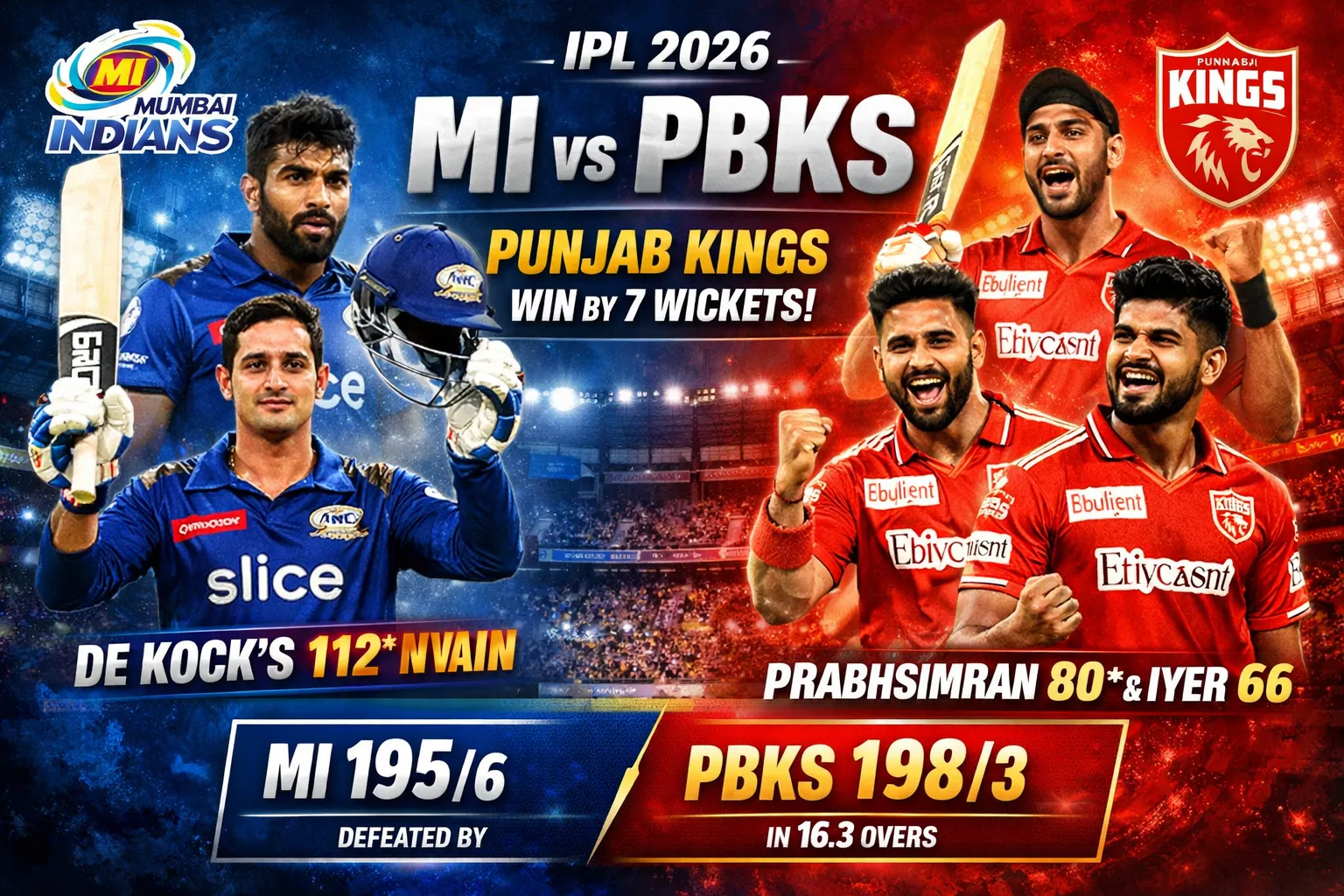
Mumbai Indians produced one of the better batting recoveries of IPL 2026, yet still walked away beaten. Punjab Kings chased 196 at the Wankhede and did it with brutal efficiency, finishing on 198/3 in 16.3 overs to win by seven wickets with 21 balls to spare. The match had one superb century from Quinton de Kock, one destructive new-ball spell from Arshdeep Singh, and then a chase that turned into a public demonstration of how settled Punjab’s batting unit looks right now.
Match at a glance 📊
- Venue: Wankhede Stadium, Mumbai.
- Toss: Punjab Kings won the toss and chose to bowl first.
- Mumbai Indians: 195/6 in 20 overs.
- Punjab Kings: 198/3 in 16.3 overs.
- Result: Punjab Kings won by 7 wickets.
- Top MI scorer: Quinton de Kock 112* off 60.
- Top PBKS scorers: Prabhsimran Singh 80* off 39, Shreyas Iyer 66 off 35.
- Best bowling for PBKS: Arshdeep Singh 3/22 in 4 overs.
MI’s innings: 12/2, then de Kock drags them back
Punjab’s decision to bowl first worked immediately. Arshdeep Singh removed Ryan Rickelton for 2 and Suryakumar Yadav for a golden duck in the third over, leaving Mumbai at 12/2. The official IPL report also notes that Arshdeep reached his 100th IPL wicket during that double-strike. That phase mattered because it transformed what should have been a platform innings for MI into a rescue mission almost from the start.
From there, Quinton de Kock took over the innings. He did not just rebuild; he kept the total alive almost single-handedly. Naman Dhir, promoted up the order, gave him exactly the support MI needed with a crisp 50 off 31 balls, and together they added 122 runs. That stand moved the match from early collapse territory into 190-plus territory and temporarily flipped the pressure back on Punjab.
De Kock’s unbeaten 112 from 60 balls was the innings around which everything else revolved. He struck 8 fours and 7 sixes, finished at 186.67, and according to the official IPL report it was his third IPL century. Cricbuzz’s post-match analysis pointed out just how isolated that effort was: MI made 195, and de Kock alone contributed 57.5% of the total. That is not support batting; that is one player carrying a full innings on his back.
The problem for Mumbai was that the innings flattened after the de Kock-Dhir stand. Hardik Pandya made 14 off 12, Sherfane Rutherford managed only 1 off 5, and Tilak Varma’s cameo ended at 8 off 3. Shreyas Iyer also produced one of the standout fielding moments of the night by taking a spectacular catch to dismiss Hardik. So while MI reached 195/6, the feeling at the interval was not that they had exploded late, but that they had left runs behind.
Arshdeep was the obvious difference-maker in the first innings. His 3/22 from four overs was the best spell on either side before the chase began, and the quality of that spell becomes even clearer when compared with the rest of Punjab’s attack. Marco Jansen gave away 30 in four, Xavier Bartlett 39 in four, Vijaykumar Vyshak 36 in three, Chahal 45 in three, while Shashank Singh chipped in with 1/19 in two. Arshdeep was the only bowler who truly controlled MI’s top order and death phase together.
Why 195/6 still felt short
This was the central tension of the match. On most nights at Wankhede, 195 is a defendable total. But it stopped feeling imposing for three reasons. First, MI were overly dependent on one batter. Second, Punjab came in as a side already confident while chasing. Cricbuzz’s live coverage noted that PBKS had now won 9 of their last 11 chases since the 2025 season and had beaten Mumbai three times in a row. Third, dew and conditions appeared to ease during the second innings. Hardik Pandya later said the ball had started reversing when MI batted, while dew arrived in the chase and made the pitch slightly better.
That made MI’s margin for error tiny. Once they did not cross 200, they needed either a dominant powerplay with the ball or a middle-overs squeeze. They got neither. Punjab attacked immediately, kept the required rate under control, and never allowed the chase to drift into panic.
PBKS chase: fast, simple, ruthless 🔥
Punjab made their intent obvious from the first over. The official IPL report says their openers Prabhsimran Singh and Priyansh Arya took 21 runs off Deepak Chahar immediately, and by the end of the powerplay PBKS were already 61/2. That scoreline alone explains the tone of the chase: even after losing two wickets, Punjab were ahead, not recovering. They were not absorbing pressure. They were erasing the target.
Allah Mohammad Ghazanfar briefly gave Mumbai a route back. He removed Priyansh Arya for 15 and Cooper Connolly for 17, finishing with 2/31 in four overs. At 45/2 after 4.3 overs, MI could still tell themselves the next wicket would reopen the game. But that third wicket never came soon enough, because Prabhsimran and Shreyas Iyer turned the chase into a procession.
Prabhsimran Singh played the innings that broke Mumbai’s resistance. He finished 80 not out from just 39 balls, with 11 fours and 2 sixes at a strike rate above 205. It was not reckless hitting. ESPNcricinfo’s coverage described it as “minimal risk, maximum reward,” and the numbers support that reading: he kept the boundary count high without turning the innings into chaos. He let the chase breathe, then crushed it.
At the other end, Shreyas Iyer was exactly what PBKS needed from a captain in a high-value chase. He made 66 off 35 balls, struck 5 fours and 4 sixes, and matched Prabhsimran’s tempo closely enough to ensure Mumbai never got a quiet phase. The partnership between them was worth 139 runs in just 66 balls. That stand effectively ended the game long before the winning shots arrived.
By the time Shardul Thakur removed Iyer at 184/3 in the 16th over, the target was already dead. Marcus Stoinis then completed the formalities with 10* off 5, including two consecutive boundaries off Deepak Chahar to close the match. Punjab’s final run rate was 12.00. When a side chases 196 at twelve an over and still has 21 balls left, that is not a tense run chase. That is total command.
Mumbai’s bowling collapse
This was the other half of the story. MI did get two powerplay wickets through Ghazanfar, but the rest of the attack offered too little bite. Deepak Chahar was hit for 45 in 2.3 overs. Hardik Pandya leaked 39 in 3. Shardul Thakur went for 42 in 3. Jasprit Bumrah, usually the stabilizer, finished wicketless again and conceded 41 in 4 overs. The official IPL report explicitly highlighted that Bumrah’s wicketless run continued, which shows how unusual and costly this phase has been for Mumbai.
ESPN’s post-match analysis was blunt about the broader problem: Hardik said Punjab “bowled better, batted better, and fielded better,” while Aaron Finch’s assessment was that except for Bumrah, MI’s bowling attack did not look threatening. Even that feels generous based on this match, because Bumrah also went at over ten an over and never exerted the control Mumbai needed in the middle overs.
What the result meant for both teams
This was not just one entertaining Wankhede shootout. It shifted the season narrative for both teams. The official IPL report said Punjab Kings moved to the top of the points table with four wins from five matches and remained the only unbeaten team at that stage. Mumbai, meanwhile, fell to a fourth defeat in five games. Hardik Pandya’s post-match comments about needing to answer hard questions and possibly make difficult calls showed how serious the concern had become inside the MI camp.
That contrast was the real takeaway. PBKS looked like a team with role clarity, order, and belief. MI looked like a team depending on isolated brilliance. Quinton de Kock’s hundred was elite, but Punjab had more complete cricket: sharper new-ball bowling, better fielding, a cleaner chase structure, and two batters who controlled the second innings without ever looking hurried. That is why a 195 score finished as a comfortable defeat instead of a defendable total.
Final verdict
If this match is reduced to one line, it is this: Quinton de Kock won the innings, but Punjab Kings won the match everywhere else. Arshdeep damaged Mumbai early, de Kock and Dhir repaired the innings, but MI never turned recovery into domination. Then Prabhsimran Singh and Shreyas Iyer produced one of the cleanest chases of IPL 2026 so far, taking apart a Mumbai attack that had no sustained answer once the powerplay ended. Punjab left Wankhede looking like genuine contenders. Mumbai left it looking like a side already forced into self-audit.