Views: 582
INTRO
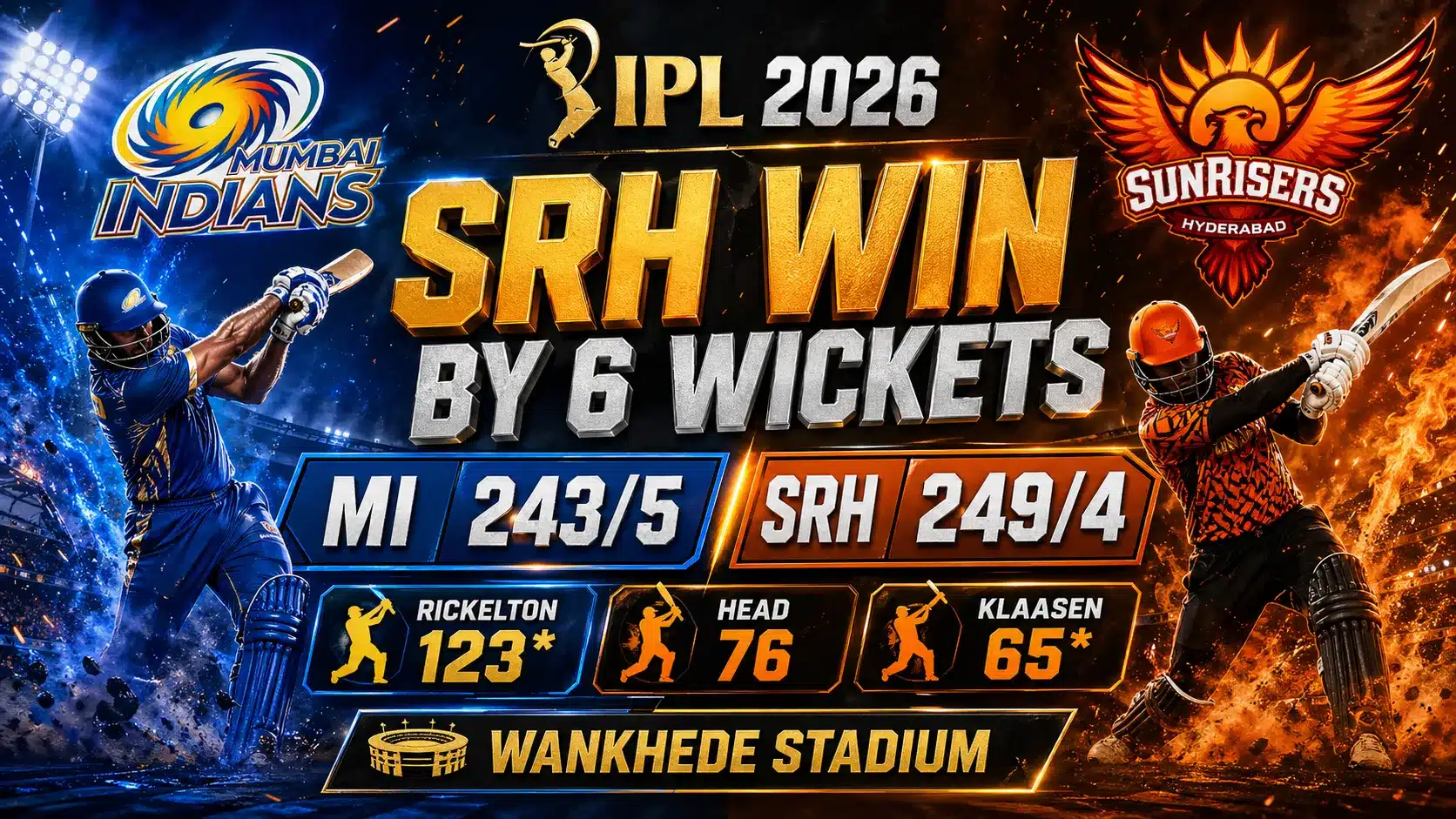
Sunrisers Hyderabad produced one of the most brutal chases of IPL 2026, beating Mumbai Indians by 6 wickets with 8 balls remaining at the Wankhede Stadium. MI posted a massive 243/5 in 20 overs, powered by Ryan Rickelton’s record-breaking 123 off 55 balls*, but SRH replied with 249/4 in 18.4 overs. The chase was built on a savage opening stand from Travis Head and Abhishek Sharma, then finished by Heinrich Klaasen and Salil Arora. The official IPL report described the match as a batting contest that “redefined the limits of a T20 contest.”
Match Snapshot 📊
| Category | Details |
|---|---|
| Match | Mumbai Indians vs Sunrisers Hyderabad, Match 41 |
| Tournament | IPL 2026 |
| Venue | Wankhede Stadium, Mumbai |
| Date | April 29, 2026 |
| Toss | MI chose to bat first |
| MI score | 243/5 in 20 overs |
| SRH score | 249/4 in 18.4 overs |
| Result | SRH won by 6 wickets |
| Balls remaining | 8 balls |
| Top MI scorer | Ryan Rickelton — 123* (55) |
| Top SRH scorer | Travis Head — 76 (30) |
| Key SRH finisher | Heinrich Klaasen — 65* (30) |
| Best MI bowler | AM Ghazanfar — 2/51 |
| Best SRH bowler | Praful Hinge — 2/54 |
| Match context | SRH’s fifth successive win; MI ninth with four points |
Cricbuzz confirms the final scoreline, venue, and result, while the official IPL report states that SRH’s win lifted them to third place and left MI ninth after four defeats in five games.
MI Innings: Ryan Rickelton Writes Mumbai Indians History 💥
Mumbai Indians’ decision to bat first looked excellent for most of the first innings. Will Jacks and Ryan Rickelton attacked from the start and took MI to 78 runs in the powerplay. The opening stand reached 93 in 43 balls, with Jacks scoring 46 off 22 and Rickelton already moving at a fierce tempo. The official IPL report noted that Rickelton was especially punishing against anything short or wide.
Rickelton’s innings was the central performance of Mumbai’s night. He stayed unbeaten on 123 off 55 balls, hitting 10 fours and 8 sixes at a strike rate of 223.64. The Times of India reported that this was both the fastest century in Mumbai Indians history and the highest individual score ever recorded by an MI batter, passing Sanath Jayasuriya’s 114* from 2008.
He reached his hundred in 44 balls, breaking MI’s previous fastest-hundred record of 45 balls, jointly held by Sanath Jayasuriya and Tilak Varma. The innings also made him only the second wicketkeeper-batter after Quinton de Kock to score a century for Mumbai Indians.
MI Batting Card 🧾
| MI Batter | Runs | Balls | 4s | 6s | Strike Rate |
|---|---|---|---|---|---|
| Will Jacks | 46 | 22 | 5 | 3 | 209.09 |
| Ryan Rickelton | 123* | 55 | 10 | 8 | 223.64 |
| Suryakumar Yadav | 5 | 5 | 1 | 0 | 100.00 |
| Naman Dhir | 22 | 17 | 3 | 0 | 129.41 |
| Hardik Pandya | 31 | 15 | 2 | 2 | 206.67 |
| Tilak Varma | 7 | 5 | 0 | 1 | 140.00 |
| Robin Minz | 1* | 1 | 0 | 0 | 100.00 |
| Extras | 8 | — | — | — | — |
| Total | 243/5 | 20 overs | — | — | 12.15 RPO |
The full scorecard shows that MI lost wickets at 93/1, 110/2, 165/3, 221/4 and 232/5, which means Rickelton carried the innings from the first over to the final ball.
Why MI Still Did Not Fully Kill the Match 📉
A total of 243/5 is usually close to match-winning. But in this match, Mumbai still left some control points exposed. After the 93-run opening stand, Suryakumar Yadav made only 5 off 5, and Naman Dhir’s 22 off 17 kept the scoreboard moving but did not produce a second major burst. Rickelton kept the innings alive, while Hardik Pandya’s 31 off 15 helped MI cross 240.
The key issue was that Mumbai’s total was massive, but not psychologically final. On a flat Wankhede surface, with dew and short boundaries helping the chase, SRH’s batting unit still had a realistic route if their openers won the powerplay. That is exactly what happened.
MI Partnerships
| Partnership | Runs | Balls | Impact |
|---|---|---|---|
| Will Jacks + Ryan Rickelton | 93 | 43 | Explosive powerplay launch |
| Rickelton + Suryakumar Yadav | 17 | 8 | Brief continuation after first wicket |
| Rickelton + Naman Dhir | 55 | 31 | Stabilized middle phase |
| Rickelton + Hardik Pandya | 56 | 27 | Death-over acceleration |
| Rickelton + Tilak Varma | 11 | 8 | Short late stand |
| Rickelton + Robin Minz | 11* | 3 | Final push |
Cricbuzz confirms the partnership progression, including the 93-run opening stand and the 56-run Rickelton-Hardik partnership.
SRH Bowling: Expensive, but Malinga Kept Some Control 🎯
SRH’s bowlers were hit hard. Pat Cummins conceded 39, Praful Hinge took 2/54, Harsh Dubey went for 50 in 3 overs, and Sakib Hussain conceded 39 in 3 overs. But Eshan Malinga’s spell stood out: 4 overs, 29 runs, 1 wicket. The official IPL report specifically called Malinga the only SRH bowler who kept any real control during the MI innings.
SRH Bowling Figures
| SRH Bowler | Overs | Runs | Wickets | Economy |
|---|---|---|---|---|
| Pat Cummins | 4 | 39 | 0 | 9.80 |
| Praful Hinge | 4 | 54 | 2 | 13.50 |
| Eshan Malinga | 4 | 29 | 1 | 7.20 |
| Harsh Dubey | 3 | 50 | 0 | 16.70 |
| Sakib Hussain | 3 | 39 | 1 | 13.00 |
| Nitish Kumar Reddy | 2 | 31 | 1 | 15.50 |
Praful Hinge got two wickets but was expensive. Malinga’s value was different: he reduced damage on a night where most bowlers were being hit at extreme rates. That difference mattered because SRH eventually chased with eight balls left, not twenty.
SRH Chase: Head and Abhishek Turn 244 Into a Powerplay Target 🚀
Chasing 244, SRH needed to attack immediately. Travis Head and Abhishek Sharma did exactly that. They tore into Trent Boult, Jasprit Bumrah, Will Jacks, and the rest of the MI attack, taking SRH to 92/0 in the powerplay. The official IPL report called the powerplay “a blur of boundaries,” and Cricbuzz confirms the mandatory powerplay score as 92 runs.
The opening stand reached 129 in 8.4 overs, with Head making 76 off 30 and Abhishek scoring 45 off 24. At the eight-over mark, SRH were already 126/0, far ahead of the required rate. That phase broke Mumbai’s defence before the middle overs even began.
Head’s innings was violent and direct: 4 fours, 8 sixes, strike rate 253.33. Abhishek’s knock was slightly less explosive but still damaging: 45 off 24, with 4 fours and 3 sixes. Together, they made the chase look smaller than it was.
SRH Batting Card 🧾
| SRH Batter | Runs | Balls | 4s | 6s | Strike Rate |
|---|---|---|---|---|---|
| Abhishek Sharma | 45 | 24 | 4 | 3 | 187.50 |
| Travis Head | 76 | 30 | 4 | 8 | 253.33 |
| Ishan Kishan | 0 | 1 | 0 | 0 | 0.00 |
| Heinrich Klaasen | 65* | 30 | 7 | 4 | 216.67 |
| Nitish Kumar Reddy | 21 | 17 | 3 | 0 | 123.53 |
| Salil Arora | 30* | 10 | 2 | 3 | 300.00 |
| Extras | 12 | — | — | — | — |
| Total | 249/4 | 18.4 overs | — | — | 13.34 RPO |
The full scorecard confirms SRH’s chase: 249/4 in 18.4 overs, with Klaasen and Salil Arora unbeaten at the end.
Mumbai’s Brief Comeback: 129/0 Becomes 133/3 ⚠️
Mumbai did create one real opening. AM Ghazanfar dismissed Abhishek Sharma and Ishan Kishan off consecutive deliveries, turning 129/0 into 129/2. Hardik Pandya then removed Travis Head at 133/3. The official IPL report described this as SRH losing three wickets for four runs, a passage that briefly reopened the match.
But the comeback did not last. Heinrich Klaasen walked in and immediately absorbed the pressure by attacking. The official IPL report says Klaasen struck six boundaries in eight deliveries between the 11th and 12th overs, shifting pressure back onto Mumbai.
Klaasen and Reddy Shut the Door 🧠🔥
The decisive stand after the wobble was the 80-run partnership between Heinrich Klaasen and Nitish Kumar Reddy. Klaasen dominated it, scoring 56 off 23 balls within that stand. By the time Reddy fell for 21 in the 17th over, SRH were already firmly ahead of the equation.
Klaasen finished unbeaten on 65 off 30, with 7 fours and 4 sixes. He gave the chase its middle-order certainty. Salil Arora then finished the job with a violent 30 off 10 balls*, including 2 fours and 3 sixes, ending the match with a six.
SRH Partnerships
| Partnership | Runs | Balls | Impact |
|---|---|---|---|
| Abhishek Sharma + Travis Head | 129 | 52 | Destroyed the chase pressure |
| Ishan Kishan + Travis Head | 0 | 1 | Ghazanfar struck immediately |
| Head + Klaasen | 4 | 5 | Transition after double strike |
| Klaasen + Nitish Reddy | 80 | 40 | Match-winning middle phase |
| Klaasen + Salil Arora | 36* | 14 | Fast finish |
Cricbuzz confirms the 129-run opening stand, the 80-run Klaasen-Reddy stand, and the unbeaten 36-run finishing stand.
MI Bowling: Wankhede Became a Punishment Zone 📉
Mumbai’s bowlers had a brutal night. Jasprit Bumrah went wicketless for 54 in 4 overs, Trent Boult conceded 41, Will Jacks gave away 19 in one over, AM Ghazanfar took 2/51, Ashwani Kumar conceded 41 in 2 overs, and Hardik Pandya took 1/39 in 3.4 overs. The Times of India highlighted Bumrah’s rare off day and Ashwani’s 20.50 economy as signs of MI’s bowling breakdown.
MI Bowling Figures
| MI Bowler | Overs | Runs | Wickets | Economy |
|---|---|---|---|---|
| Trent Boult | 4 | 41 | 1 | 10.20 |
| Jasprit Bumrah | 4 | 54 | 0 | 13.50 |
| Will Jacks | 1 | 19 | 0 | 19.00 |
| AM Ghazanfar | 4 | 51 | 2 | 12.80 |
| Ashwani Kumar | 2 | 41 | 0 | 20.50 |
| Hardik Pandya | 3.4 | 39 | 1 | 10.60 |
Hardik Pandya later said he would not “put the bowlers under the bus” and admitted Mumbai had not executed well as a unit. He also pointed to missed chances and dropped catches as momentum-killers.
Match Phase Comparison ⚡
| Phase | MI | SRH | Advantage |
|---|---|---|---|
| Powerplay | 78/0 | 92/0 | SRH |
| Overs 7–10 | MI lost Jacks and SKY | SRH reached 133/3 after brief wobble | SRH |
| Middle phase | Rickelton + Dhir added 55 | Klaasen + Reddy added 80 | SRH |
| Death/finish | MI reached 243/5 | SRH finished in 18.4 overs | SRH |
| Final result | 243/5 | 249/4 | SRH |
The phase comparison is blunt: MI’s score was huge, but SRH were faster in the powerplay, stronger in the middle-order recovery, and cleaner in the finish.
Key Turning Points 🔥
| Moment | What Happened | Why It Mattered |
|---|---|---|
| MI powerplay | 78/0 | Mumbai built a huge base |
| Rickelton century | 123* off 55 | MI reached 243/5 |
| SRH powerplay | 92/0 | SRH destroyed the asking rate |
| Opening stand | Head-Abhishek added 129 in 52 balls | Chase pressure disappeared |
| Ghazanfar double strike | Abhishek and Kishan out back-to-back | MI briefly reopened the match |
| Head wicket | SRH slipped to 133/3 | Mumbai had one real window |
| Klaasen counterattack | 65* off 30 | Closed MI’s comeback window |
| Salil Arora finish | 30* off 10 | SRH won with 8 balls left |
| Result impact | SRH fifth straight win | Hyderabad moved to third |
The biggest turning point was not the final over. It was SRH’s powerplay. A chase of 244 becomes psychologically different when the chasing side reaches 92/0 after six overs.
Records and Context 📚
Rickelton’s 123* became the highest individual score by a Mumbai Indians batter and his 44-ball hundred became the fastest century in MI history. MI’s 243/5 also ranked among their highest IPL totals.
SRH’s chase of 244 was reported by Economic Times as the fourth-highest successful run chase in IPL history. The same report noted that SRH completed it with eight balls to spare and that Mumbai suffered their sixth defeat in eight matches.
The official IPL report added that this was SRH’s fifth successive win, lifting them to third place, while MI remained ninth with four points.
Tactical Reading: Why SRH Won 🧩
SRH won because they attacked the target with correct sequencing. Head and Abhishek did not “set up” the chase slowly. They cut the required rate immediately by scoring 92 in the powerplay. That forced Mumbai to chase wickets rather than defend runs.
The second tactical reason was Klaasen’s timing. When SRH slipped from 129/0 to 133/3, MI had a chance to create pressure. Klaasen killed that chance by attacking within two overs, not by waiting for the equation to settle.
MI lost because their bowling had no control phase. They had a massive total, but they could not string together two quiet overs after the powerplay. Dropped chances and poor execution made the problem worse, and Hardik’s post-match comments reflected that frustration.
Final Verdict 🏁
Mumbai Indians had the historic individual innings. Sunrisers Hyderabad had the better chase architecture. Ryan Rickelton’s 123* deserved to win many matches, but this one belonged to Travis Head’s powerplay violence, Abhishek Sharma’s support, Heinrich Klaasen’s middle-over control, and Salil Arora’s finishing burst.
The scoreboard says SRH won by 6 wickets. The deeper story is sharper: MI made 243 and still looked second-best once SRH reached 92/0 after six overs.
Author

Ernest Shpilevoy
Author