INTRO
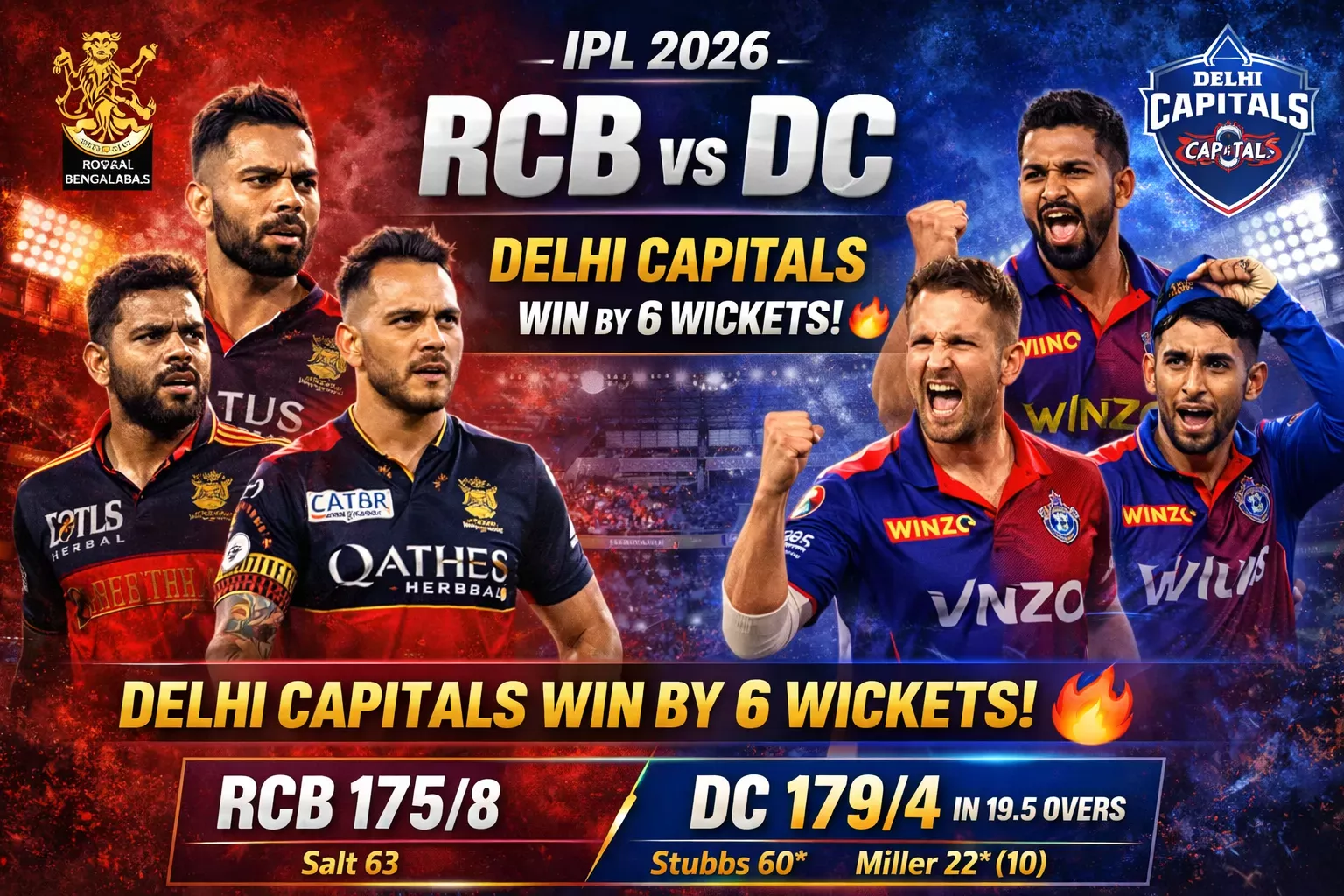
Delhi Capitals pulled off one of the sharpest chases of IPL 2026, beating Royal Challengers Bengaluru by 6 wickets at the M. Chinnaswamy Stadium with one ball left. RCB posted 175/8 after being asked to bat first, but DC recovered from a brutal 18/3 collapse to reach 179/4 in 19.5 overs. Tristan Stubbs anchored the chase with an unbeaten 60, KL Rahul counterattacked for 57 on his birthday, and David Miller finished the match with a violent burst in the last over.
Match summary 📊
The basic match data below comes from the official scorecards and match reports.
| Category | Details |
|---|---|
| Match | Royal Challengers Bengaluru vs Delhi Capitals, Match 26 |
| Venue | M. Chinnaswamy Stadium, Bengaluru |
| Toss | Delhi Capitals won the toss and opted to bowl |
| RCB total | 175/8 in 20 overs |
| DC total | 179/4 in 19.5 overs |
| Result | Delhi Capitals won by 6 wickets |
| Player of the Match | Tristan Stubbs |
| Top scorer, RCB | Phil Salt — 63 off 38 |
| Top scorer, DC | Tristan Stubbs — 60* off 47 |
| Best bowler, RCB | Bhuvneshwar Kumar — 3/26 |
| Best bowlers, DC | Axar Patel — 2/18, Kuldeep Yadav — 2/32, Lungi Ngidi — 2/39 |
The shape of the match: RCB start fast, stall late; DC collapse early, then rebuild better
This game had two opposite arcs. RCB flew to 59 in the powerplay and looked set for a much bigger total, but then lost wickets too regularly and scored only two boundaries in the last six overs, with no boundary at all in the final two overs. DC, in contrast, were wrecked at 18/3 inside three overs, yet still reached 50/3 by the end of the powerplay and eventually controlled the chase better in the middle and at the death. That contrast — one side starting well and fading, the other starting disastrously and recovering — explains the result better than the final score alone.
RCB innings: Salt gave them lift, but the middle and death overs failed them
Axar Patel chose to bowl first, and the surface reportedly felt a little tacky early. Phil Salt ignored that almost immediately. He attacked with clean intent, made 63 off 38, and drove RCB’s early scoring. Virat Kohli supported with 19 off 13, and together they carried RCB to 52/1 in 5.1 overs and 59/1 in the powerplay. At that stage, Bengaluru looked positioned for 185-plus, maybe even 190-plus, especially at Chinnaswamy.
RCB’s batting card is based on the full scorecard.
| RCB batter | Runs (Balls) | 4s | 6s | Dismissal |
|---|---|---|---|---|
| Phil Salt | 63 (38) | 4 | 3 | c Stubbs b Kuldeep |
| Virat Kohli | 19 (13) | 3 | 0 | c Nissanka b Ngidi |
| Devdutt Padikkal | 18 (13) | 1 | 1 | c Miller b Axar |
| Rajat Patidar | 8 (4) | 0 | 1 | c Rahul b Mukesh |
| Tim David | 26 (17) | 3 | 1 | c Natarajan b Axar |
| Jitesh Sharma | 14 (20) | 1 | 0 | c Miller b Ngidi |
| Romario Shepherd | 1 (4) | 0 | 0 | lbw b Kuldeep |
| Krunal Pandya | 12 (10) | 0 | 1 | run out |
| Rasikh Salam Dar | 0* (0) | 0 | 0 | not out |
| Bhuvneshwar Kumar | 3* (2) | 0 | 0 | not out |
The problem for RCB was not the start. It was everything after it. Salt’s innings gave them momentum, but once Kohli fell at 52/1, DC kept striking at the right moments. Padikkal added 18, Patidar only 8, and Salt himself fell at 105/3 in the 10.4th over. From there RCB never assembled one decisive partnership that could turn the innings into a 185-190 total. Tim David’s 26 off 17 was useful, but it stayed in the cameo range rather than becoming an innings-defining finish.
The score progression shows where Bengaluru lost control. They were 99/2 at the end of the 10th over, 131/4 after 12.4, 146/5 after 15.2, and then only 175/8 at the finish. ESPN’s report was blunt: RCB scored just two boundaries in their last six overs and none in the last two. Former captain Faf du Plessis, quoted there, felt they were about ten runs short at the innings break. Reuters quoted Rajat Patidar even more directly, saying RCB were “15-20 runs short.”
Delhi did not bowl a perfect innings, but they bowled a winning one. Ngidi removed Kohli and later Jitesh Sharma. Kuldeep got the key wicket of Salt and then trapped Shepherd. Axar was the most economical among the major wicket-takers, giving away only 18 from his 3 overs while dismissing Padikkal and Tim David. T Natarajan’s contribution is easy to overlook, but his 2 overs for 16 were specifically highlighted in the official report as a crucial part of the death squeeze.
DC’s bowling figures come from the scorecard.
| DC bowler | Overs | Runs | Wickets | Economy |
|---|---|---|---|---|
| Auqib Nabi Dar | 3 | 36 | 0 | 12.00 |
| Mukesh Kumar | 4 | 32 | 1 | 8.00 |
| Lungi Ngidi | 4 | 39 | 2 | 9.80 |
| Kuldeep Yadav | 4 | 32 | 2 | 8.00 |
| T Natarajan | 2 | 16 | 0 | 8.00 |
| Axar Patel | 3 | 18 | 2 | 6.00 |
This was one of those innings where wickets mattered more than economy in isolation. DC allowed Salt to get away, but they prevented RCB from building a long assault. Every time Bengaluru hinted at acceleration, another wicket landed. That is why 175/8 looked competitive but not commanding.
DC chase: 18/3, then Rahul changed the entire mood of the game
RCB’s defence began almost perfectly. Bhuvneshwar Kumar produced a classic swing spell. He removed Pathum Nissanka lbw, then dismissed Karun Nair and Sameer Rizvi in quick succession. According to ESPN’s ball-phase summary, DC were 18/3 inside three overs; by the scorecard they were 2/1, 16/2, and 18/3 by 2.5 overs. In conditions where 176 was already a respectable chase target, that looked like the decisive passage.
But KL Rahul refused to let the chase become a collapse. He scored 57 off 34, hit 6 fours and 2 sixes, and most importantly counterpunched rather than merely surviving. ESPN’s report notes that Rahul scored 31 of DC’s 50 powerplay runs, and 22 off just 10 balls against Josh Hazlewood, a matchup in which no other batter has a better T20 record. Reuters described it as a composed innings; the official IPL report called it one of the most vital knocks of the game. Both descriptions are true. Rahul did not just stabilize. He reversed the pressure.
The DC batting card below comes from the full scorecard.
| DC batter | Runs (Balls) | 4s | 6s | Dismissal |
|---|---|---|---|---|
| Pathum Nissanka | 1 (2) | 0 | 0 | lbw b Bhuvneshwar |
| KL Rahul | 57 (34) | 6 | 2 | c Kohli b Krunal |
| Karun Nair | 5 (5) | 1 | 0 | c Salt b Bhuvneshwar |
| Sameer Rizvi | 2 (3) | 0 | 0 | c Jitesh b Bhuvneshwar |
| Tristan Stubbs | 60* (47) | 4 | 1 | not out |
| Axar Patel | 26 (19) | 3 | 0 | retired hurt |
| David Miller | 22* (10) | 1 | 2 | not out |
Rahul and Stubbs added 69 for the fourth wicket, which was the first real turning point of the chase. It was not a reckless stand. Rahul attacked more aggressively, Stubbs absorbed and organized. When Rahul fell at 87/4 in the 10.1st over, DC were back in the contest but not yet ahead. The required rate was still manageable, yet RCB still had an opening.
Stubbs’ innings was the difference
Tristan Stubbs’ unbeaten 60 was not the most explosive innings in the match, but it was the most complete. He was only 18 off 17 when Rahul got out. He then accelerated selectively, especially in the 13th over against Rasikh Salam Dar, and kept the chase alive without burning through risk. ESPN described his innings as an effort that turned crisis into control. That is accurate. He held the innings together through three different situations: collapse recovery, middle-overs calculation, and death-overs pressure.
Axar Patel’s 26 off 19 also mattered. He did not dominate the innings, but his 47-run stand with Stubbs for the fifth wicket prevented RCB from reopening the game after Rahul’s dismissal. Then came another complication: Axar retired hurt. At that moment, DC still needed 42 off 25 balls, and the chase was alive again. Hazlewood and Bhuvneshwar tightened things with yorkers and reverse-swinging stump lines, exactly as ESPN’s report described.
Final over: Miller finished the game brutally 💥
The decisive scene came at the very end. DC needed 14 off the last over. Rajat Patidar handed the ball to Romario Shepherd. ESPN’s report lays out the sequence clearly: Stubbs took a single, and then Miller attacked three consecutive scoring balls with 6, 6, 4. The first six came off a full toss over midwicket, the second off a wide half-volley over extra cover, and the winning boundary came off another full toss flicked to the midwicket fence. Miller, who earlier in the season had failed to finish a chase against Gujarat Titans, this time closed the job with a ball to spare.
That finish changed how the scoreline will be remembered. Officially, it is a six-wicket win. In reality, it was a chase that moved through three separate emotional states: collapse, repair, and ambush. Stubbs made the ambush possible. Miller detonated it.
Key moments table ⚡
The phase summary below is drawn from the scorecard and match reports.
| Match phase | What happened | Why it mattered |
|---|---|---|
| RCB powerplay | 59/1 | RCB earned the kind of start that should normally produce 185+ |
| RCB death fade | Only 2 boundaries in last 6 overs; none in last 2 | Bengaluru left runs behind |
| DC collapse | 18/3 inside 3 overs | RCB had the chase under immediate stress |
| DC powerplay recovery | 50/3 | Rahul prevented the chase from breaking |
| Rahul-Stubbs stand | 69 for the 4th wicket | Rebuilt the innings and normalized the equation |
| Stubbs-Axar phase | 47-run stand | Held the chase together after Rahul fell |
| Final over | Miller hit 6, 6, 4 | Match-ending blow |
What the result means
Reuters reported that the win lifted Delhi to fourth in the table with six points, while RCB remained second on eight points. The same report also noted a venue milestone: this was Bengaluru’s 100th IPL match at the Chinnaswamy, making them the first team to play 100 IPL games at a single venue. That should have been a celebratory afternoon for the home side. Instead, it became their first home defeat of the season and only their second defeat overall.
Final verdict
RCB lost this match twice: first when a 59/1 powerplay turned into only 175/8, and second when Bhuvneshwar’s 18/3 opening burst was not converted into a full defensive choke. DC won it twice as well: first through Rahul’s refusal to let the chase collapse, and then through Stubbs’ control at the back half of the innings before Miller smashed the door down at the end. On a ground where chases often become chaos, Delhi were the side that held their nerve longer and hit harder when the match finally tilted.