Views: 566
INTRO
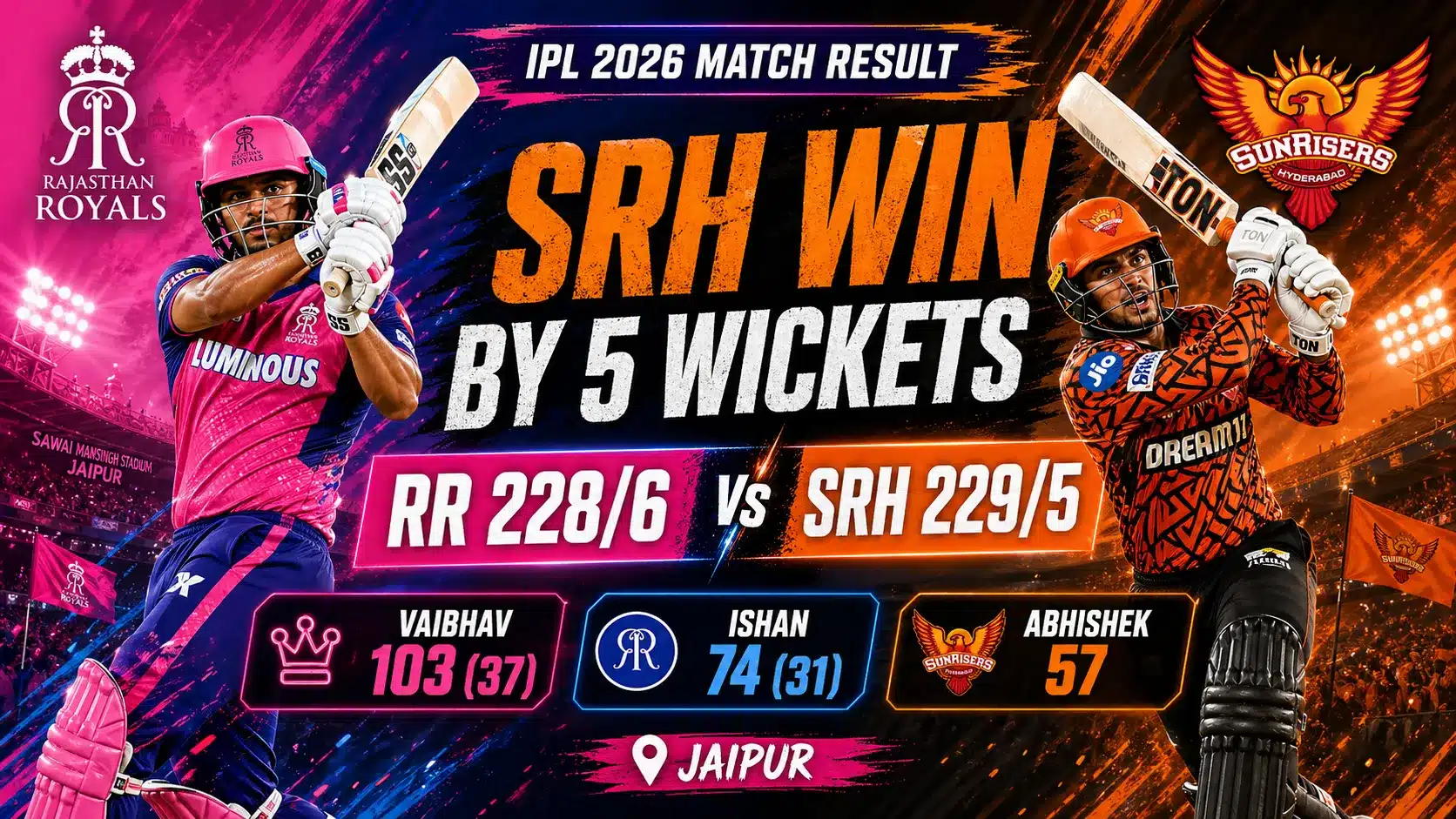
Sunrisers Hyderabad pulled off a ruthless chase against Rajasthan Royals in Jaipur, winning by 5 wickets with 9 balls remaining. Rajasthan posted a huge 228/6 in 20 overs, powered by Vaibhav Sooryavanshi’s extraordinary 103 off 37 balls, but SRH replied with 229/5 in 18.3 overs after a blistering chase led by Ishan Kishan, Abhishek Sharma, and Nitish Kumar Reddy. The official IPL report called it a stunning chase in a high-scoring match dominated by aggressive batting.
The official scorecard and match reports confirm the essentials below.
Match snapshot 📊
| Category | Details |
|---|---|
| Match | Rajasthan Royals vs Sunrisers Hyderabad, Match 36 |
| Venue | Sawai Mansingh Stadium, Jaipur |
| Toss | SRH won the toss and chose to bowl |
| RR total | 228/6 in 20 overs |
| SRH total | 229/5 in 18.3 overs |
| Result | SRH won by 5 wickets |
| Player of the Match | Ishan Kishan |
| Top RR scorer | Vaibhav Sooryavanshi — 103 (37) |
| Top SRH scorer | Ishan Kishan — 74 (31) |
| Best SRH bowler | Eshan Malinga — 2/38 |
| Best RR bowler | Jofra Archer — 2/34 |
Cricbuzz’s scorecard confirms the result, totals, venue, Player of the Match, and full innings details.
RR innings: Vaibhav Sooryavanshi turned Jaipur into a six-hitting exhibition ⚡
Rajasthan Royals were asked to bat first, and the early overs immediately became a Vaibhav Sooryavanshi show. Yashasvi Jaiswal made only 10 off 8, but Vaibhav attacked from ball one and gave RR the kind of powerplay that normally wins matches. Rajasthan reached 76/1 after six overs, with Vaibhav already shaping the innings around clean six-hitting and fearless tempo.
Vaibhav’s innings was the headline act of the match. He smashed 103 off 37 balls, hitting 5 fours and 12 sixes at a strike rate of 278.38. Reuters reported that he reached his hundred in 36 balls, the third-fastest century in IPL history, behind Chris Gayle’s 30-ball hundred in 2013 and Vaibhav’s own 35-ball century from the previous season. He also became the youngest player and fastest by balls faced to reach 1,000 T20 runs, completing the mark in just 473 balls.
The most frightening part for SRH was how quickly Vaibhav took control after surviving a dropped chance. Rajasthan’s own match report says Aniket Verma dropped him when he was on 32, and Vaibhav then raced to a 15-ball fifty before reaching the hundred in the 14th over. That missed chance changed the first innings: RR were no longer building a strong score; they were threatening something above 240.
Dhruv Jurel gave Vaibhav proper support. He made 51 off 35 balls, with 8 fours and 1 six, and the pair added 112 runs for the second wicket. That stand moved RR from 40/1 to 152/2, and it gave the innings its strongest structure. Jurel did not match Vaibhav’s violence, but he kept the scoring moving and prevented SRH from creating pressure through dots.
RR batting card
| RR batter | Runs | Balls | 4s | 6s | Strike rate |
|---|---|---|---|---|---|
| Yashasvi Jaiswal | 10 | 8 | 2 | 0 | 125.00 |
| Vaibhav Sooryavanshi | 103 | 37 | 5 | 12 | 278.38 |
| Dhruv Jurel | 51 | 35 | 8 | 1 | 145.71 |
| Riyan Parag | 7 | 9 | 0 | 0 | 77.78 |
| Donovan Ferreira | 33 | 16 | 3 | 3 | 206.25 |
| Shimron Hetmyer | 11 | 10 | 1 | 0 | 110.00 |
| Ravindra Jadeja | 4* | 3 | 1 | 0 | 133.33 |
| Jofra Archer | 2* | 2 | 0 | 0 | 100.00 |
| Extras | 7 | — | — | — | — |
| Total | 228/6 | 20 overs | — | — | 11.40 RPO |
The scorecard shows RR were 170/3 after 13.5 overs, then 191/4 after 16.1, and finally 228/6. That means they still scored well, but they did not fully convert the Vaibhav-Jurel base into the 240-plus total that looked possible.
Why RR still left runs behind 📉
This sounds strange after a score of 228, but Rajasthan did leave runs behind. The official IPL report says RR could not fully capitalize in the latter half after a flying powerplay and regular wickets slowed the finish. The report also noted that beyond Vaibhav and Jurel, contributions were limited, leaving RR slightly short of the total that looked possible from their start.
Donovan Ferreira helped push the score late with 33 off 16, including 3 fours and 3 sixes, but the rest of the lower middle order did not create a full death-overs explosion. Riyan Parag made 7 off 9, Hetmyer made 11 off 10, and the final overs lacked the sustained boundary flow that RR needed after such a dominant opening half.
RR innings phases
| Phase | RR score | Interpretation |
|---|---|---|
| Powerplay | 76/1 | Explosive start, Vaibhav in full control |
| Overs 7–14 | 94/2 | Vaibhav-Jurel stand kept RR above 12 RPO |
| Overs 15–20 | 58/3 | Strong, but not ruthless enough after the platform |
| Final total | 228/6 | Huge score, but chaseable on the night |
SRH bowling: expensive, but they kept taking timely wickets 🎯
SRH’s bowling figures were expensive because Vaibhav hit almost everyone hard. Still, they took wickets at enough moments to stop RR from crossing 240. Eshan Malinga returned 2/38, removing Jaiswal and Ferreira. Pat Cummins gave away only 27 in 4 overs while taking Riyan Parag’s wicket. Sakib Hussain was expensive at 1/62, but he got the biggest wicket of the innings: Vaibhav Sooryavanshi.
SRH bowling figures
| SRH bowler | Overs | Runs | Wickets | Economy |
|---|---|---|---|---|
| Praful Hinge | 4 | 49 | 1 | 12.20 |
| Pat Cummins | 4 | 27 | 1 | 6.80 |
| Eshan Malinga | 4 | 38 | 2 | 9.50 |
| Sakib Hussain | 4 | 62 | 1 | 15.50 |
| Shivang Kumar | 2 | 31 | 0 | 15.50 |
| Nitish Kumar Reddy | 2 | 20 | 1 | 10.00 |
Cummins’ spell was the quiet stabilizer. On a night where several bowlers were going above 12 or 15 runs per over, his 4-0-27-1 kept the innings from fully escaping SRH. That mattered more in hindsight because SRH chased the total with only nine balls left.
SRH chase: early wicket, then Abhishek and Ishan ripped the match open 🔥
Jofra Archer gave Rajasthan the perfect start by dismissing Travis Head for 6 off 5 in the first over. RR had a chance to apply early pressure, especially with 229 on the board. Instead, Abhishek Sharma and Ishan Kishan immediately reversed the innings. SRH reached 89/1 in the powerplay, which was faster than RR’s already impressive 76/1. That opening six-over response effectively told Rajasthan that 228 was not enough unless they kept taking wickets.
The central partnership of the chase was the 132-run stand between Abhishek and Ishan. Times of India described it as a 132-run partnership off only 55 balls, and Rajasthan’s match report also identifies that stand as the phase where SRH took control. Abhishek made 57 off 29, while Ishan blasted 74 off 31, and the asking rate was crushed before RR could build scoreboard pressure.
Ishan Kishan’s innings was the chase-defining knock. He scored 74 off 31 balls, with 11 fours and 3 sixes, at a strike rate of 238.71. Cricbuzz lists him as Player of the Match, and that makes sense: Vaibhav produced the most spectacular innings, but Ishan produced the innings that actually won the game.
SRH batting card
| SRH batter | Runs | Balls | 4s | 6s | Strike rate |
|---|---|---|---|---|---|
| Travis Head | 6 | 5 | 0 | 1 | 120.00 |
| Abhishek Sharma | 57 | 29 | 11 | 1 | 196.55 |
| Ishan Kishan | 74 | 31 | 11 | 3 | 238.71 |
| Heinrich Klaasen | 29 | 24 | 3 | 1 | 120.83 |
| Nitish Kumar Reddy | 36 | 18 | 2 | 3 | 200.00 |
| Salil Arora | 8* | 3 | 0 | 1 | 266.67 |
| Aniket Verma | 1* | 1 | 0 | 0 | 100.00 |
| Extras | 18 | — | — | — | — |
| Total | 229/5 | 18.3 overs | — | — | 12.38 RPO |
The chase after Ishan: SRH slowed slightly, but never lost control 🧠
Rajasthan did create some late drama. Donovan Ferreira removed Abhishek, Archer returned to dismiss Ishan, and Brijesh Sharma took the wickets of Nitish Kumar Reddy and Heinrich Klaasen in the 18th over. Rajasthan’s match report says that double strike made the ending nervous, but it came too late because SRH still needed only 41 from the final five overs and had already built a huge base.
Nitish Kumar Reddy’s 36 off 18 was the overlooked finishing contribution. He hit 2 fours and 3 sixes, keeping the chase ahead even after Abhishek and Ishan fell. Klaasen’s 29 off 24 was more controlled, but it gave SRH a stabilizing presence through the middle. Salil Arora then closed the chase with 8 off 3*, including the finishing hit, as SRH reached the target in 18.3 overs.
SRH chase phases
| Phase | SRH score / event | Why it mattered |
|---|---|---|
| 0.5 overs | Head out at 7/1 | RR got the early wicket they needed |
| Powerplay | 89/1 | SRH beat RR’s powerplay tempo |
| Abhishek-Ishan stand | 132 runs | Broke the chase open |
| Ishan wicket | SRH 166/3 | RR briefly reopened the contest |
| Final 5 overs | SRH needed 41 | Chase was still under SRH’s control |
| Finish | 229/5 in 18.3 overs | SRH won with 9 balls left |
RR bowling: Archer struck early, but the rest leaked too much 📉
Jofra Archer was RR’s best bowler. He took 2/34 in 4 overs, removing Head and Ishan, the two wickets Rajasthan most needed at different points. Brijesh Sharma also took 2/44, dismissing Klaasen and Nitish Kumar Reddy to create late drama. But the wider bowling card shows the problem: Nandre Burger conceded 50 in 3.3 overs, Tushar Deshpande gave away 43 in 3, and RR also used several part-time overs that SRH attacked hard.
RR bowling figures
| RR bowler | Overs | Runs | Wickets | Economy |
|---|---|---|---|---|
| Jofra Archer | 4 | 34 | 2 | 8.50 |
| Nandre Burger | 3.3 | 50 | 0 | 14.30 |
| Tushar Deshpande | 3 | 43 | 0 | 14.30 |
| Brijesh Sharma | 4 | 44 | 2 | 11.00 |
| Riyan Parag | 1 | 12 | 0 | 12.00 |
| Donovan Ferreira | 1 | 14 | 1 | 14.00 |
| Ravi Bishnoi | 1 | 16 | 0 | 16.00 |
| Ravindra Jadeja | 1 | 11 | 0 | 11.00 |
The official IPL report identified RR’s inability to sustain pressure with the ball as a major reason for the defeat. Rajasthan also had dropped chances, especially against Abhishek Sharma, which the report says they would rue later. In a 229 chase, missed chances and expensive overs cannot coexist.
Key turning points ⚡
| Match phase | What happened | Why it mattered |
|---|---|---|
| Vaibhav’s first-over assault | Four sixes early in his innings | SRH were immediately forced onto the back foot |
| Vaibhav dropped on 32 | Aniket Verma missed the catch | RR turned a good start into a century innings |
| Vaibhav-Jurel stand | 112-run partnership | Built RR’s 228 base |
| RR slowdown | RR finished below the 240+ range | SRH stayed within chasing distance |
| Archer removes Head | SRH 7/1 | RR got a perfect opening |
| SRH powerplay | 89/1 | Hyderabad seized chase momentum |
| Abhishek-Ishan stand | 132 off 55 balls | The decisive partnership |
| Brijesh double strike | Klaasen and Nitish fell late | Created drama but not enough control |
| Salil Arora finish | SRH won in 18.3 overs | Hyderabad closed the chase with 9 balls left |
Records and context 📚
Vaibhav Sooryavanshi’s hundred was the night’s historic landmark. Reuters reported that he became the youngest and fastest by balls faced to complete 1,000 T20 runs, reached the landmark in 473 balls, and hit his second IPL century with 12 sixes and five fours. His 36-ball hundred ranked as the third-fastest in IPL history, behind Chris Gayle’s 30-ball hundred and Vaibhav’s own 35-ball hundred from the previous IPL season.
Rajasthan’s own report added that RR’s 228/6 was the highest IPL score at the Sawai Mansingh Stadium, beating the previous best of 219/5 set by Punjab Kings the previous season. That makes the defeat even sharper: Rajasthan set a venue scoring benchmark and still lost with nine balls remaining.
Reuters also reported that after this match, SRH and RR were both on 10 points, four points ahead of fifth-placed Chennai in the playoff race at that stage, while Punjab Kings led the table with 13 points. That gives the result proper table context: this was not just a batting spectacle; it was a top-four pressure match.
Tactical reading: why SRH won 🧩
SRH won because they did not let the chase become a last-five-over lottery. They attacked the powerplay harder than Rajasthan did, even after losing Head early. Abhishek and Ishan understood the equation perfectly: on a flat Jaipur surface, chasing 229 required immediate damage, not cautious consolidation.
RR lost because they had two separate failures. First, they did not extract the full value from Vaibhav’s innings. From 170/3 in the 14th over, they had a route toward 245. They finished with 228. Second, their bowling never found a sustained squeeze. Archer gave them wickets, but the other overs leaked enough runs that SRH could absorb later wickets without panic.
Final verdict
RR had the most spectacular innings of the match. SRH had the better match plan. Vaibhav Sooryavanshi’s 103 off 37 was a generational batting performance, but Ishan Kishan’s 74 off 31 and Abhishek Sharma’s 57 off 29 turned the chase into a controlled assault. SRH did not steal this game at the end. They won it early in the chase, when they reached 89/1 in the powerplay and removed the fear from a 229 target.
Author

Ernest Shpilevoy
Author